A Show of Hands, by Rhiannon Swann-Price
What is this?
A Show of Hands is a TTRPG of disembodied sentient hands in a traveling circus who work together to solve crimes1. It's written by Rhiannon Swann-Price2 and published by We Evolve, and it's a one-shot, GM-less game for 2-5 players.
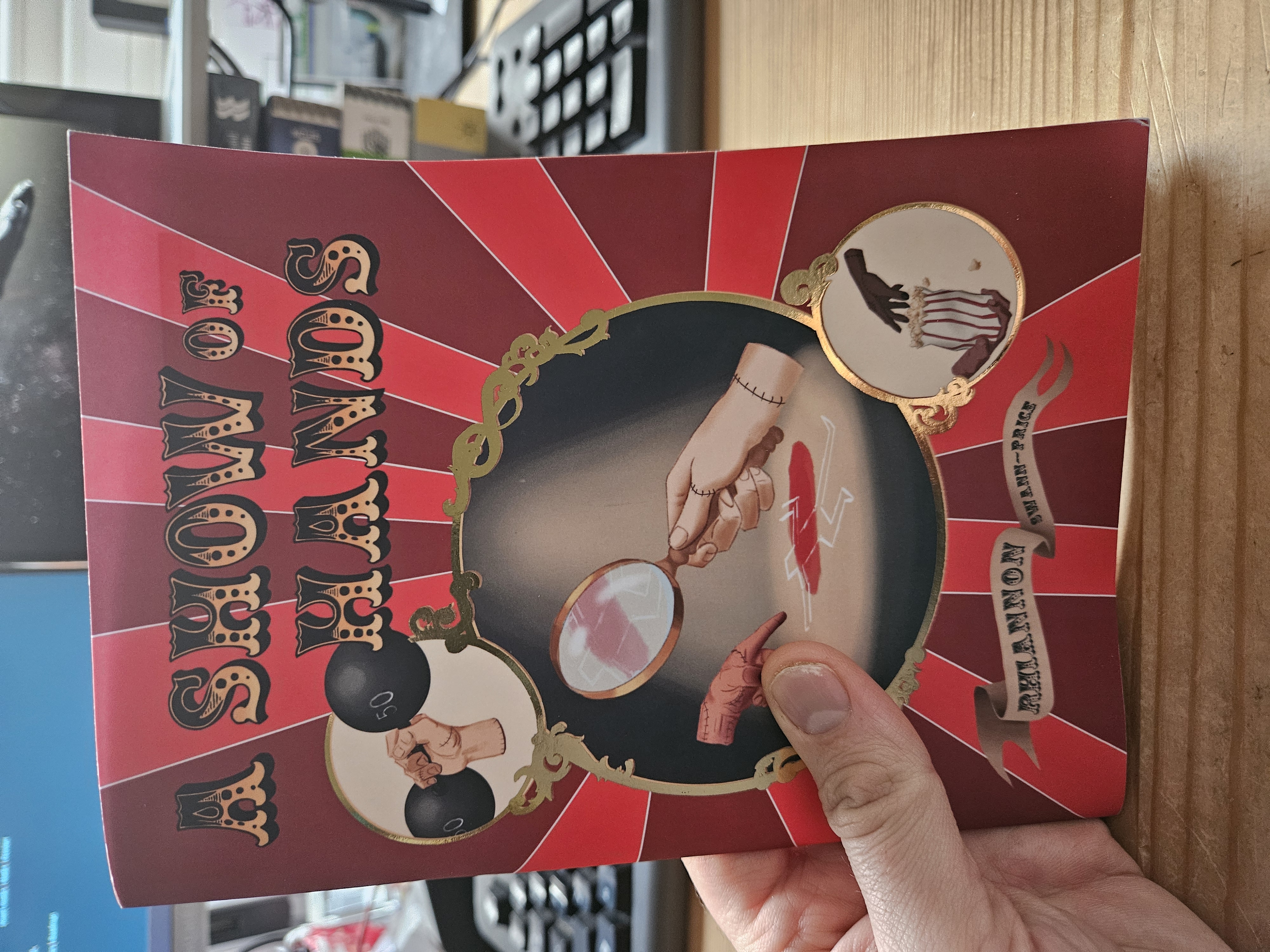
The zine has a full colour cover (and the softcover edition has foil!) and 40 B&W text pages.
Why do I have this?
I saw it advertised in the UK TIN server when it was on Kickstarter and the concept seemed cool (plus cheap shipping). Later Stoo Goff of We Evolve asked me to sell it at Leeds Zine Fair, which I duly did3
Level of Review: Deep Dive
This is another short zine, so reading the whole thing is a breeze. I haven't had the opportunity to play it, which is a shame! When I do I shall be back to update this review.
Vibe Check
As the kids say4, the vibes here are absolutely immaculate. The cover hits a great note of bright and sinister -- the cameo of the disembodied hands fulfilling that second note perfectly -- and the colours are all the fun of the circus. The gold foiling around this central cameo piece is very nicely done, and overall it is eye-catching, clever, and deeply intriguing.
The blurb and testimonials5 on the back set up the tone perfectly: this is not an entirely serious game. It makes me so keen to dig in.
Flick Through
First up -- inside covers with comprehensive rules summaries? That's what we should be using inside covers for. Simple, elegant, smart. The layout designer has done a great job with this.
For the second time in as many reviews, this zine has a contents page, which has a lot of entries (very useful as a reference guide), and I see a very long guided example at the end (also for the second time in as many reviews). This is demarcated in the zine by being white text on black pages, which is a great decision because it makes it very easy for me to find them. I'm absolutely stoked to see another long guided example in a short game; I think this is one of the best ways to learn a small indie game that's unlikely to get a channel doing an AP of it, and when it's based on the designer's playtesting, then it's a shortcut into understanding what the game is about.
The layout is simple but clever, easy to read and unfussy. My major gripe is that there are some boxed parts of the white-on-black section which are harder to read, at least in low light. There are delightful illustrations throughout, really enhancing my reading of the text; the style (simple but well-executed lineart) makes these pieces stand out against the text block, and they're all carrying weight with the text.
I slightly take issue with the paper choices here. The text paper stock is thick, and at forty pages this forces the cover sheet to bend quite alarmingly. We're at the limit of what staple binding can do here. One or two weight classes down on the paper and this would have been near perfect.
Because I've made a thing of checking this, I also checked the acknowledgements, but unfortunately found no indication of who had edited or laid out6 A Show of Hands. Which is a shame, because I wanted to praise their work: it's great. I would presume, then, that it's either Rhiannon Swann-Price themself, or Stoo Goff.
Still, overall? I love this. We're going to get along.
Deep Dive
What are we looking at here, then? This is a GM-less game about a group of disembodied hands (the circus hands) solving crimes in a weird and uncanny travelling circus. It being GM-less, the mystery is emerging throughout play: you investigate the crime, find clues, follow leads, and ultimately confront the perpetrator in a final showdown.
Before we dig in: It was hard to go into this game without making (obvious) comparisons with Meguey & Vincent Baker's Under Hollow Hills, another TTRPG about a weird travelling circus. That's a game I absolutely love, but based on a sample of (now) two, I can safely say that "weird sinister/supernatural circus" appears to be exactly my jam. Almost as soon as I started reading this game, I realised that making comparisons was totally unnecessary: this piece stands up on its own completely.
One of the main things you might know about this game is that it's "that game where you make your character sheet on your actual human hands". When I first picked up this game, I wondered about whether this would manage to stick the landing, as sometimes that kind of gimmick falls flat, either because it gets too goofy, or it gets to be nothing more than set dressing. Swann-Price does neither of these: this game is an excellent example of how to seamlessly blend setting, narrative, and mechanics. It's fun, y'all. It's hella fun.
Firstly, the tone is extremely well-pitched. Swann-Price writes this in the third person plural ("we", "us", etc.) which makes it feel both very personal, and a little bit sinister. Why, exactly, are we writing about ourselves like this? Because it gives us a sense of collusion, which for this particular game feels like the absolute best decision. It's written to be fun to read, as well as play, and there are absolutely loads of hand puns (not so many that it's off-putting, mind). If I had but one gripe, it would be to complain about the large number of exclamation marks, but, it also feels endearing (complimentary) to read a text written like an early 00s MSN conversation.
Secondly, the mechanics are actually very neat. This little gimmick of using your hands is leaned on heavily: you draw a tattoo on your hands, you mark off scenes with tally marks on your digits, you write words on your knuckles to get bonuses, you make marks on your lifelines to mark off damage. Swann-Price has made this work without making it hammy, and it feels clever.
One thing that I particularly liked: you get to choose which method you use on how to resolve conflict. The options given are thumb war, rock/paper/scissors, tossing a coin, or rolling dice. This lets you pick and choose in the moment which you're most comfortable with. It's the kind of design decision which is rife throughout this text: prioritising comfort and consent in the name of having fun.
To speak to this in more detail: There's an essay written by one of the playtesters about how to avoid ableism and ickiness with regards to 20th Century circuses and their sideshows, and this felt well-planned and well-executed. Swann-Price also makes explicit reference to people with disabilities that would make playing this game as written more challenging. At every step there has been a thought on how to make this game work for people, and how to make that fun. Genuinely, it's a joy to see, especially in such a short text.
The mechanics being fairly simple, there wasn't much to wonder on, and the most complicated aspects were well-explained in sentences almost Le Guin-esque in their terseness. If ever I found myself wondering "oh, hey, how does that work?", the answer was almost always provided in an example on the same page, or in the example of play at the end.
As a GM-less game with an emergent mystery, it feels really important to get the structure of the game right, and I think Swann-Price nails that with A Show of Hands. There is a clear description of what to do in each of the four Acts, and you're given a way to record this by make tally marks on your phalanges. As a structure, this absolutely kicks ass. Again, it's just smart design, and just enjoyable to think about.
If I were to make one comment on the mechanics: the length of Scenes is dependent on getting a certain number of successes based on the number of players. This increases with later and later acts, so Scenes, clues, and leads get more and more complicated as the game goes on. I think in practice I would turn this on its head, and try to use early Scenes to generate a large number of clues that we could whittle down later. But it's a small criticism of what's otherwise a very good system.
In addition to the careful frameworking, Swann-Price gives good advice about how to play GM-less games in general, and this particular(ly weird) game in particular. None of this feels like wasted words; au contraire, it's timely and succinct, something many writers of similar sections could stand to learn from.
Thirdly, the setting itself, whilst sparse in some regards (Swann-Price being open about almost everything) gives you some delicious details, like the porridge pot in the cook tent or how, exactly, the clowns are so sinister. It's not really discussed why there are disembodied hands roaming around helping the circus folk, but to be honest I think the game is better for it: they're here, they're weird, they'll probably get you a beer. It's fun, and it's not overwrought.
All of these things work really well together, and there's practically no wasted text. I have honestly never seen anything quite like this game: it lists only media touchstones as opposed to a ludography, and I can't think of any game that's quite like it, with the possible exception of (what I understand of) Esther and the Queens.
Before I move on, I really must give a special mention to the Example of Play, which works wonderfully well to explain how the game is meant to be played. And it's an example which feels dynamic, realistic, funny for gods' sake, and genuine. This must be a game that actually took place; there's no way it's contrived7. The first Scene from each Act is painstakingly written out, with boxed text for the mechanical challenges and a summary of the skipped Scenes laid out in terms of clues. It's very well done. I personally would perhaps have mixed up which particular Scenes from each Act I would have followed, but that just feels nitpicky, and honestly I think as examples of play go, this is as close to flawless as ever I've seen.
Final Thoughts
This zine is absolutely great. From the really eye-catching cover, through the immaculate set-up, to the really fresh-feeling mechanics, and on to the near-flawless example of play, every aspect is carefully considered and wonderfully executed. I will play this game the next opportunity I get, and I'll report back, because this was probably the best zine I've read this year.
To really summarise: if you're a fan of weird circus tales, strange little critters trying to solve crimes, and fun little toys as mechanics, please give this game a try. I think you'll love it as much as I did.
And keep an eye on Rhiannon Swann-Price. They're one to watch.
Because of course?↩
I have been informed by Stoo Goff that Rhiannon Swann-Price is not present on social media, which is a shame because based on this they're someone I want to follow.↩
Of all the zines on sale that day, this one was a) the easiest to pitch to people; and b) the one that people picked up and flicked through the most.↩
Or not. I'm not really up to date with the lingo. Apparently kids don't actually say "skibidi" either.↩
I presume these are fake, because they're mostly from pun names, but who knows, to be honest.↩
Laid out? Lain out? Done layout? Answers on a postcard.↩
Or else Swann-Price is just an excellent author, I suppose.↩