Apawthecaria, by Anna Blackwell & Brian Tyrrell
What is this?
Apawthecaria is a solo journalling roleplaying game about tiny creatures having big adventures, diagnosing and curing ailments for the creatures you meet, exploring an imagined Scottish landscape, and building community. It's written by Anna Blackwell and Brian Tyrrell, and is published by Stout Stoat Press.
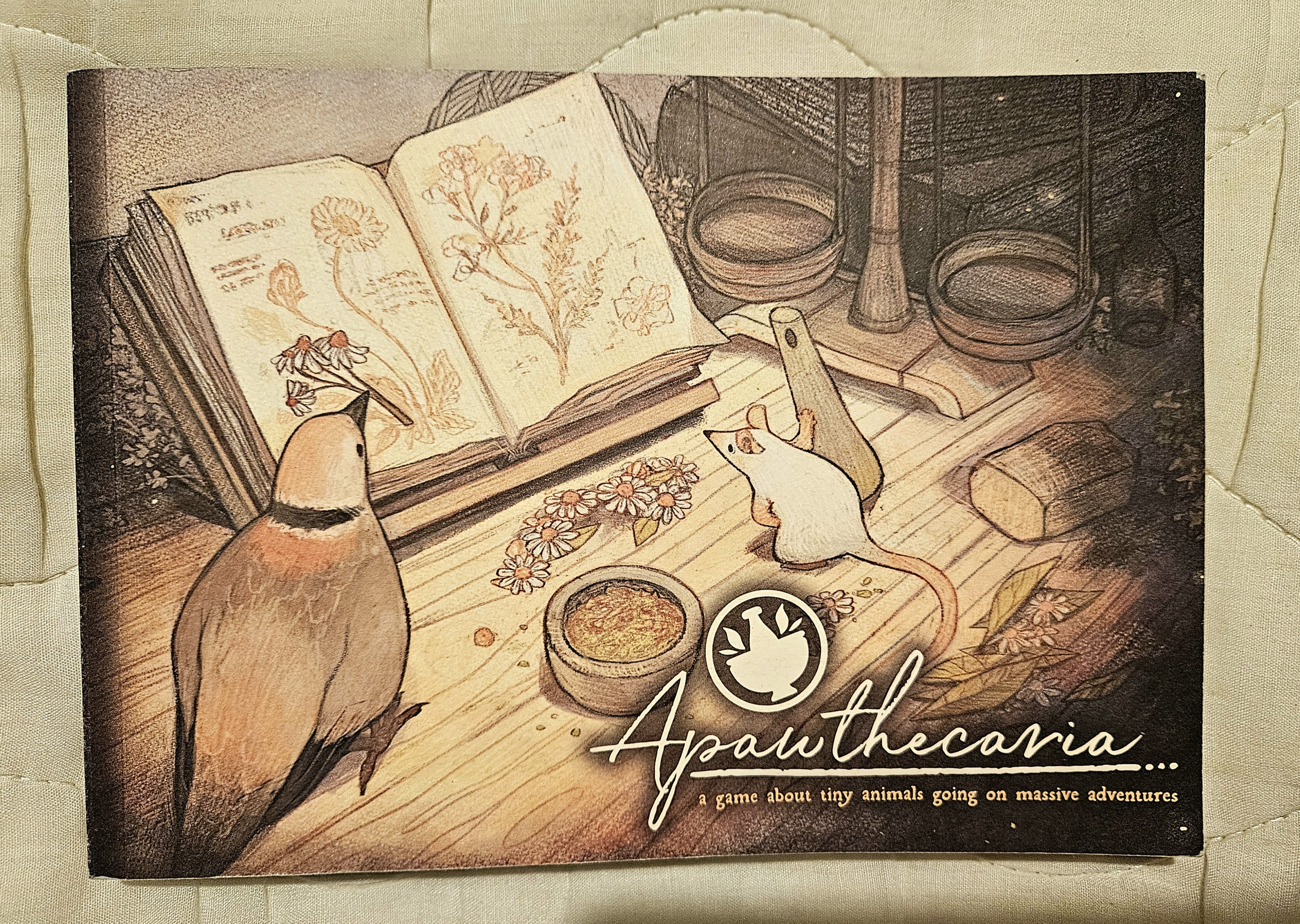
To be honest, readers, this is probably my favourite game I've read this year, and I'm absolutely thrilled to bring you this review.
Why do I have this?
I bought this direct from Stout Stoat from their stand at the Thought Bubble games and comics convention in maybe 20231. It really jumped out to me as a cute little game, but it's absolutely more than that2.
Level of review: Deep Dive
This is a bigger book, 200+ pages in small format, but I've read the whole thing and checked back through it for some extra rules clarification. I wasn't going to read it all, because it contains some spoilers and secret information that might change how you play, but I've done it anyway.
I do intend to play this game, as soon as I can, so I will extend the review to cover a playthrough when I do. Update: I'm in the process of doing a playthrough of this game, and it's been a wonderful experience. I'll write up how I feel about this game, and make a few amendments to the review, as my thoughts come up.
Vibe Check
Before we even get to the aesthetics of the game, the thing that really stands out to me is that it's a freakin' landscape format book. It stands out from the pack by virtue of being visually completely unlike almost anything else I have. That's probably the reason I picked it over anything else Stout Stoat had on sale that day.
Secondly, the cover is uncoated rather than gloss, which is a massive draw. On the back it actually says "printed on ethically sourced and sustainably recycled paper." Now, I'm a nerd when it comes to ethical paper choice, so this is exactly targeted to me.
Thirdly, the very cute picture of a mouse and bird staring at an illustrated botanical book on a lectern is very cool. The subject perfectly conveys the theme of the game, with the muted autumnal colours doing the same for the tone. It's a great and honest pull into the world of the game.
The blurb on the back reinforces all of this, and adds in just the right amount of intrigue to get me into the book. What's a Poulticepounder? What's a behemoth barrow? What about a titan? And this is in Scotland? Well, beam me up Scotty3.
One note: nowhere does it tell me this is a game. Is this intentional? Is this good? I don't know. My clues were contextual: I knew of the authors, and the publisher. This makes it harder to guess whether it's a "first time roleplayer" kind of game. I think it could be! But it's not obvious from the back cover.
Staff roll is on the credits page: Brian Tyrrell built on Anna Blackwell's original (Apothecaria) rules, and Blackwell did some of the writing work too, with Tyrrell and Fiona Geist doing the editing. Tyrrell did layout, and the illustrations come from a massive list of artists4.
Flick-Through
This is a weighty book. It's 200+ pages, and, not to be crass, it was phenomenal value. There's just so much in this book, from a really solid and comprehensive set of base rules, to a series of rules expansions, and then through a detailed and lengthy almanack covering every aspect of play. There's evidently so much replayability in this game, not just because you'll want to come back to it, but because it offers the kind of "new game plus" options that incentivise repeat play in novel ways. This is, in short, great marketing (and cool game design).
The book is also gorgeous. The number of artists on the credits page is a hint to this, but it's thicc5 with art, from full page, full colour illustrations; through beautiful page textures that wouldn't look out of place on a Victorian home's walls; to humorous and satirical spot art that might have jumped out of the margins of an illuminated manuscript.
It's not just the illustrations, though – Tyrrell has done exceptional work on the layout. I can flick to any page and know roughly what section of the book it's from. There's great use of typography, and the colour choices are both pleasing and clever (playing into the layout choices, to be honest).
The contents page is well divided, and totally necessary. Also there's not only a blank character page, but a sample (filled-out) one, which is much-needed in this moderately crunchy game. Also the game comes with a fold out, separate map glued into the back. This is a great resource for play6!
One (minor) complaint is that there's no index, which makes it annoying to look up some of the rules (which I did on my read-through a few times). I know that write indices is a skill and it's more labour than is widely appreciated, but it's just on the cusp of being necessary for this book, and the omission feels a bit annoying. Also, the text on the map is probably too small for me to read comfortably with the contrast on the page; contextually, if the map were twice the size, this wouldn't be a problem. Lastly, the format is very slightly awkward to read in the hand, mostly because of the effect of weight at the longer distance from the fingers to the spine! If I'd made like the cover characters and used a lectern, we'd be fine here, but I kept dropping it when reading it in bed7.
These are annoyances, not bad marks. On the whole, Apawthecaria feels well-structured and immaculately presented.
Deep Dive
The book starts off with two clever ideas: an introduction to the mechanics of play, and an outline of the loop of play. This is crucial, because for a journalling game, Apawthecaria is crunchier than I'm used to. Understanding the concepts of the game from the outset is not only welcome, but necessary.
There's a safety section here, by the way, which includes literal, physical safety. Don't collect reagents in the wild and expect them to fix your ailments, folks. You need training in botany to do that! Kudos to Blackwell & Tyrrell for pointing this out.
This game has a great character creation system which gives you not only a well-rounded and interesting character, but also a purpose, a companion, and a sense of direction. By giving you a goal and a timescale, it sets the limits of play from the off. In a journalling game, one of the more open-ended formats in TTRPGs, this is a good addition.
The mechanics of play (drawing cards against prompts) seem simple, but there are a lot of moving parts to keep a track of: time in days when travelling, time in hours when foraging, weight, reagent tags and potency and rarity, foraging points, distance, and so on. The character sheets are great for this (particularly the automated PDF ones), but it makes the game slightly less approachable. I'd have to sit down and make time for Apawthecaria, rather than dip in and out as I have done with other solo games. This isn't bad – like I said, I want to play this game. It's just something to be aware of, if moderate crunch isn't your thing.
On the other hand, one of the things that Blackwell & Tyrrell have excelled at is providing you with actionable prompts. This is a thing that many solo games fail to do; they provide you with the prompts, but bury the lede on what to do with them. Here, you're told to "journal about X and Y," and given leading questions that get you to open up about what you think and feel. This is smart design, and one many games could stand to learn from.
The addition of "new game plus" and extra coop game modes at the end of the rules text is, as I mentioned before, an excellent choice. It makes the game really expandable in ways that will make the world feel real and lived in, even more so that just playing the game again normally. I like what's been done with the rules to this end – in particular, explaining the nuances of playing in a large, busy Discord server is interesting in its own right. I'd love to try it in this open world style, but I'd equally love to try it in a slower format, like playing it cooperatively by post (possibly literal post), or playing it in "caravan mode" with one of my kids.
The Almanack itself is well-organised and full of clever little roleplaying prompts, hard choices about resources, and genuinely joyous and celebratory descriptions of landscapes, places, and people. As well as lists of ailments, reagents, tools, and upgrades, there are travel encounters, foraging encounters, and social encounters, most of which are 60-70 prompts each. There must be in excess of 300 prompts in this book, all of them considered carefully in the context of journalling, many presenting you with a choice, and a fair few containing mini-games that seem genuinely engaging.
One particularly good bit of writing is the gradual revelation of the setting through the prompts. As you play, you find out what titans and behemoths and beasts are; you meet characters with real depth and warmth, like Griph the Gorilla or the Philosopher Goats; you get to feel what's happened to the world, and more crucially what's happening to it now; and you're invited to make your own decisions about the lore. There's canonical lore here, but it's dynamic and evolving in the most glorious sense.
This brings me onto another point, actually: Apawthecaria is both serious and quiet, and really, actually funny. It contains jokes, humour, pop culture references, nerd culture references, and other tidbits that make it fun to read. The ailments, as well as being sometimes gross, sometimes touching, sometimes harrowing, are packed with amusing ideas about how to represent and play ill people, and grief and mortality, and so many other things. I hadn't intended to read the entire Almanack start to finish, but I wanted to read through the social encounters, and I wasn't disappointed.
That invitation to change things extends even to the map, as the prompts (and the downtime actions, and the journey end rules, and more) ask you to add paths, add settlements, change places, and sometimes even remove settlements. As a collector of things, this does make me shudder, imagining making changes to my lovely uncoated foldout map, but I need to print it at double A2 anyway to read it, so I guess it's less of an issue...
I do have a few very minor gripes with the text of the game, and they're as follows. Firstly, the rules are a bit scattered over the fifty pages where they sit, and whilst the processes are clear and well-established, some of the nuance of rules (and, particularly, a key for the encounters) gets lost in this. Again, I think an index would have helped with this, and the two pages optimistically headed "Notes" at the end might have been a good location for a quick index, but I appreciate it's detailed labour.
Secondly, a few examples of play or a sample journal wouldn't have gone amiss. I personally love seeing these in journalling games (Sam Leigh's Anamnesis is a great example), because they're a shortcut into the designer's brain with regards to tone, content, and theme. Here, a journal annotated with the mechanics of play would have really rounded off the rules text.
Thirdly, and said with great love and respect, this text really needed a proofreading pass. There were a fair few typographical errors scattered through the text. No howlers, and not like Runequest 1e level bad, but enough to irritate my (editor) brain. When the attention to detail on the layout and art direction is so hot, finding words and letters out of place is a bit jarring. Hire a proofreader! They're cheap!
Final Thoughts
Apawthecaria is cleverly written, immaculately designed, and beautifully brought together. It's funny, touching, heartwarming, and wry, and it features a world that feels real and lived-in, and almost in touching distance, whilst being just out of reach.
Like Redwall and Brambly Hedge, it contains deep, broad, relatable characters doing real, funny, profound, foolish, brave things. And food. Lots of food.
As well as being a smart play experience, it's also fantastically put together in a book that looks and feels like it belongs in Nanny Ogg's bookshelves. If it sounds remotely up your street from this review, you should honestly go out and buy it, because I honestly don't think you'd regret the purchase.
Sure, it has a pawful of minor ailments, but sometimes you have to make a mistake to show that you're not better than god. They're nothing a second edition couldn't fix; the bones of this game are set right.
Blackwell, Tyrrell, thank you so much. You've made a wonderful, heartwarming, interesting game that feels like the perfect intersection of what I want my own games to feel like, and my own interests.
Yes, it really takes me that long to get around to reading things.↩
When I started reading it, I hadn't realised how close this game is to the ideas that I wanted to explore in my (unpublished!) game The Drover's Almanack, in which you walk across an (imagined) 18th Century Scottish landscape with 100+ bored cows in tow. So much so, in fact, that I'm having a crisis of design in whether I want to just hack Apawthecaria to explore this different aspect instead. But that's for another time.↩
Don't you dare.↩
In order of how much stuff they put in, most first: Brian Tyrrell, Bern Lehtinen, Atlanta Pritchard-Barrett, VER (the amazing cover artist), Ell J Walker, Jenny Mure, Anine Bosenberg, Ema Acosta, Cecilia Ferri, Aimee Lockwood, AnneMarie Rogers, Eli Spencer, and Paige Brooklyn.↩
I went there. Sue me (don't).↩
… which you can also download from the game's store page.↩
Much to my partner's amusement.↩