Burnborough, by Gwen Howard
What is this?
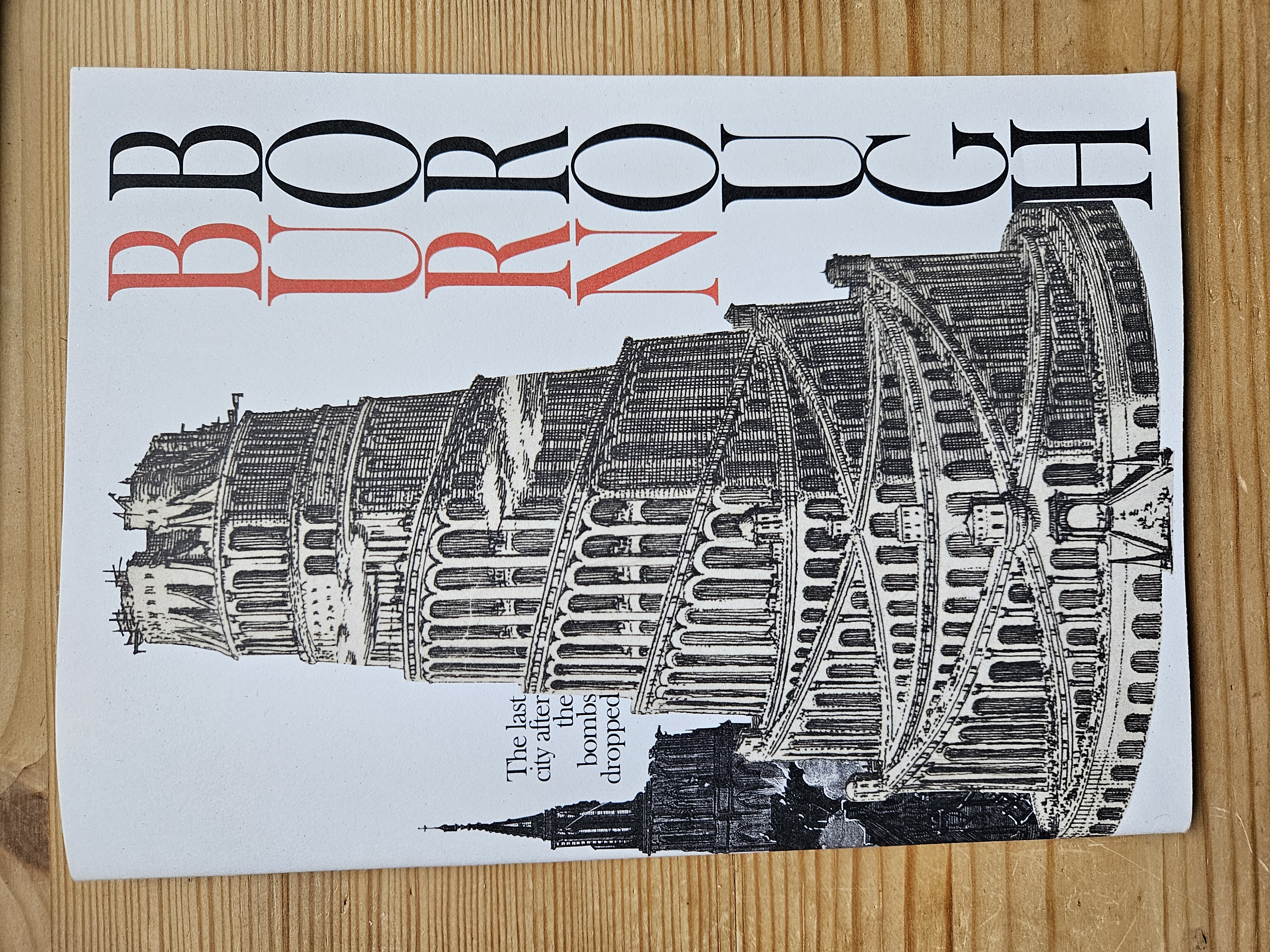
Burnborough, "the last city after the bombs dropped", is a rules-lite ttrpg which is created by Gwen Howard. I have it in print; it's an A5 staple-bound zine in uncoated paper in full colour, 18 pages of content plus covers.
Why did I get this?
I'm a member of the UK TIN Discord server, and the Kickstarter for Burnborough was promoted there by the author (IIRC). I backed in based on a) the vibes of the page, because it's not the kind of thing I'd normally buy; and b) that postage for the print edition was affordable for me in the UK.
Level of review: Deep Dive
This is a deep dive review: I'll read the whole thing through and give you my thoughts. This is more than a vibe check (preview) or a flick through (shallow read), but less than enhanced deep dive (includes checking out an actual play). There are a few tiers above Enhanced Deep Dive too that would include me playing, but they're irrelevant here.
Vibe check
The paper weight has been carefully chosen, and it feels nice in the hand, quality generally feels good. The cover is (I think!) a public domain image, one that looks like the Tower of Babel. The back has some other public domain images, sketch-like illustrations of complex architecture or industrial cityscapes. The typeface is strong: a serif font, often all caps and in very large letters, visually striking.
The front cover gives me the general impression that this is a setting or location book, but that's settled on the back page with "a rules-lite TTRPG created by Gwen Howard". Personally, I think Howard could have put that on the front page.
The blurb on the back says "In the new industrial age, how do you keep hope alive while everything burns?". This is something that really intrigues me, actually -- I love working class and industrial stories in TTRPGs, which is something I think gets left out by the pursual of gold, fame, and riches.
There's a list of "with help from" but no specific roles listed; this bugs me perhaps more than it should, because I don't know who edited it1 or laid it out. I presume all the illustration is public domain, because I vaguely recognise some of it.
Overall, if I were to see this at a shop or zine fair, I'd be likely to pick it up. I think I'd be likely to buy it, too, although it would depend on the price given that I'm less likely to play it.
Flick through / deep dive
It's only eighteen pages long, so there's not going to be much difference between the two levels here. The impression I get from flicking through is of bleak "slice-of-life" OSR in a kind of post-apocalyptic Industrial Revolution-era London. To me, that's appealing -- I'm into the idea of twisted Victoriana, and there's always something attractive to me about depicting London as, as my northern colleague once said, "the worst place in the world".
First impressions are that it's a very maximalist layout in the vein of Mörk Borg: pages are printed full bleed, attention has been paid to the placement of everything, and the design feels stylised and artistic. It looks beautiful; but, it's hard to parse at a glance for that, at least for me. Given that it's relatively simple and light in game design terms, I think that's probably fine, but if this were any longer I'd struggle to find what I wanted quickly (or even to get through it in the first place).
Character creation is randomised for stats, with the kind of strict ordering that will have min-maxers reeling2. It has some nice prompts for memories and hooks, but what really gets into the mood is the flavour text:
Canaries in the coal mine, you owe a hefty debt to your generous Landlords and thus you are the first to be sent into the front lines, pits and disaster areas.
Howard, I'm with you. I'm in your world now.
What really helped me get into the designer's head are the career packages on the next page. This d66 table (on which you can also roll 2d6, apparently) is a list of collections of items which really tell you about the technology level and the world, but also? Wonderful things like "Black Lung", "Caustic Burns", "Prophetic Dreams". I guess they imply "classes", but it's only implied, this is clearly intended as a classless system. The table wins bonus points from me for being backdropped over a 19th Century Ordnance Survey map of London3. The last bit on the page is a very small statement about starting the game in an excruciating (and random!) amount of debt, like Electric Bastionland I suppose.
The next spread, over a very detailed P.D. still-life, is all about Memories, which look like a core part of what separates this game from other OSR stalwarts (maybe; I don't actually know this). Memories are made in character creation (and include your character's name, which is quite cute), and they feel like an equivalent to Trauma in Blades in the Dark: when you experience a "horrific event", or are reduced to 0 in a stat or resource, you cross one out as you forget it. When you forget your name, you're out of the game for good. There's a kind of nudge at the bottom that you can gain new memories when you experience good things, but, spoiler warning, that's not going to happen.
The next spread is rules. They're very simple. It's a roll-under system, if you're interested, and uses a d20, 2d6, and a d12 (my favourite). There's a very specific call-out to saying that Everything Is Optional, which is something I appreciate in a game.
There's a very simple system of damage on the next spread, which feels straightforward although somewhat reliant on GM discretion, which perhaps some players might feel a bit disenfranchised by.
Logically, the next spread is an anatomical diagram with a list of Injuries around it, which you take when you hit 0 HP. You can gain memories from this injury, which is quite an interesting way to extend characters' lives. Again, this spread is rich with flavour about the world you're playing in: there's a whole list for burn injuries, which are gross but thankfully not graphic. The injuries are, incongruently with the rest of the rules, not at all lightweight, but it's not necessarily that hard to work them out, just at odds with the otherwise simple rules.
In the next spread we see A Spark of Hope, which talks about how the GM should introduce hope to the characters, and The City, which is a big, big overview of the setting. They're both delightful in their writing, and the ideas embedded within are something I'd be interested in exploring. If I were going to be picky, I would say: put this spread much, much further up in the book. It's the only explicit bit of worldbuilding, and without it I have little to go on when I'm making my character.
The next two spreads give you more playable elements: The Factories, which are extremely brutalising environments; and The Mines, which are more or less immediately lethal to player characters. It's about as far as the author goes in giving you hints about what to do; I guess as a self-confessed story gamer this isn't exactly my cup of tea, but I think it's notable that the cleverly written text (exactly my cup of tea) is all that there is to hint as to what PCs do (something I, as a GM, would struggle with).
The Mines is the last spread in the book, so I'll move on to my final impressions.
Final Thoughts
Firstly, this zine is gorgeous. The vibes, as they say, are immaculate, and when you dig into the writing it's really smartly written: Howard has done so much with so little. The use of public domain art is absolutely on point, and the kitbashing that's gone on in the background is very smart. There are a lot of evocative, clever prompts that give you a clear idea of what Howard is driving at with this world, and it's a set of ideas (hope! despair! anguish! pain!) that I'd be interested to explore in play, with the right group of people.
For a GM, it doesn't provide you with a lot of actionable stuff, and that's to its detriment, honestly. I've seen a lot of one-page games that give you prompts to get you instantly into a story, and Burnborough doesn't quite have this. To be fair, OSR-style games aren't really my thing, and that I'd struggle to pick this up and play it. I really and truly don't hold that against it, but if you're not already playing this kind of game, it feels a lot less approachable than other games in the tradition.
Being picky, I would say: please stick the worldbuilding stuff right at the front, please at least give me a picture of what a character sheet would look like (this would be very useful for Memories), and please credit who edited the zine.
Overall, if hopeless and bleak OSR-style adventures in post-apocalyptic and yet industrial revolution-era London sounds like your cup of tea, and you're used to playing this kind of game, then this is absolutely the game for you.