Camp Elementa, by Edaureen Muhamad Nor
What is this?
Camp Elementa is "a Six Elements game by Edaureen Muhamad Nor". It's a roleplaying game for 1-6 players about teenagers born to elemental parents at a sleepaway camp for the same. I've got the (signed!) print edition, which is an A5 staple-bound softcover zine with 44 full-colour text pages plus covers.
Why do I have this?
I've been following Nor's work for a while. She made a supplement for ghostbox (on commission from me) as part of the crowdfunding effort for that game, and I've been interested in her stuff ever since. When this game came up on Kickstarter, I backed it at the signed edition tier pretty quickly, partly because it sounded right up my street, partly because my kids were on a Classical Elements Fantasy bender at the time, and partly because shipping a zine to the UK was affordable.
Level of review: Deep Dive
At 44 text pages, a lot of which are play aids and other supplementary material, I can stretch to reading the whole thing. I haven't heard or seen it played, and I haven't played it myself.
Vibe Check
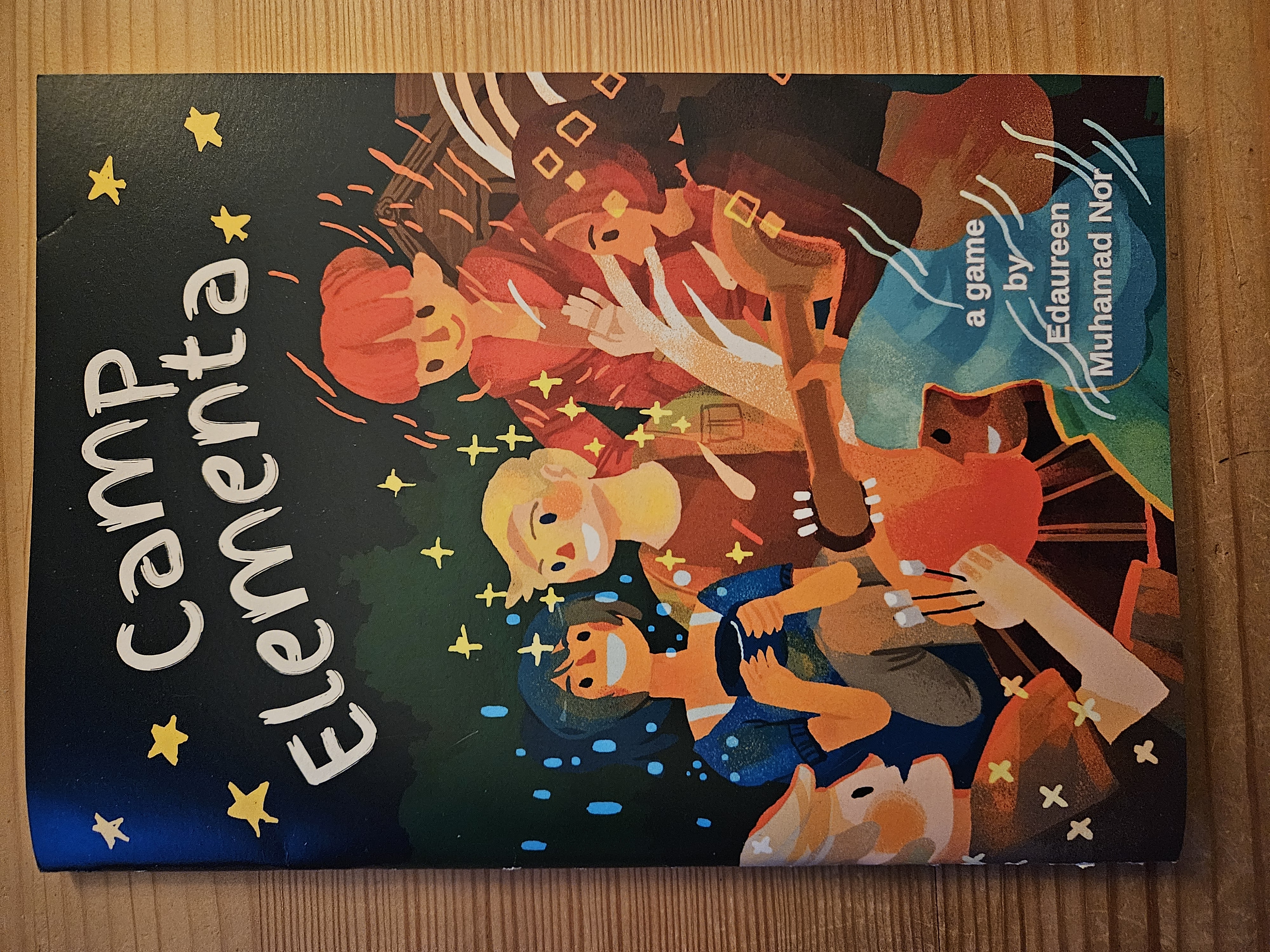
The cover is astonishingly pretty1. There's this full-bleed, full-colour vivid, bright, unshaded illustration of six kids sitting around a campfire playing guitar and toasting marshmallows. There are little sparks and waves around them, I guess as hints to their elements, and in the starry night sky the words "Camp Elementa" in a child-like handwritten typeface. Honestly, gorgeous. Totally gives me an understanding of what to expect.
In case you didn't quite get it, though, there's a detailed narrative blurb on the back, including a list of all the stuff you need to play (an essential, for me).
There's this little border around the blurb on the back where you can see mountains and forests and it's very pretty too, hints at part of this illustration unused!
Nor has made a good paper choice here - a decent weight matte cover, and medium weight satin inners. There's a lot of pages, so it gapes at bit at the gutter, but on the whole I think it's a well printed zine, kudos.
Flick-through
The credits page doesn't list a layout designer so I presume that Nor did it herself. It's a great job - information is presented cleanly and precisely. Typefaces are well chosen, there are a lot of well-designed play aids in the book, and the visual language is smartly and sparsely used throughout.
There are some illustrations, but only a cover artist listed, so I presume these are public domain images. They're of different styles, but they're used well so it doesn't feel out of place. A bit of clarity would be useful on where these came from.
If I have one complaint it's that the text blocks are often quite big, and feel dense. But I guess the alternative would be for the zine to be about twice as long, and given the generous whitespace around the blocks and the almost luxurious graphic design, it just about breathes okay.
Deep Dive
This zine has a table of contents, which is a first for me, but I'm into it because it means I can see what's coming up. One thing I noticed is that there's a list of days which covers about a half of the actual text pages. From the introduction page, this seems to be a kind of guided starting campaign; this feels like a pretty interesting innovation for a GM-less game, and I'm interested to see how it sticks the landing.
Nor presents the ideas of her Six Elements universe succinctly, and there's enough lore presented here to get me into the world. In other games, Elementals tend to be quite one-dimensional, but here the idea is that all people are different blends of the six elements. This is a great way to move away from the possibly bio-essentialist ideas of Elementals in traditional fantasy stories, and I'm really in favour of this. In fact Nor specifically calls this out in one particular page (A Note About Archetypes), and I think this is certainly to her credit here.
These ideas carry through into character creation in that you get a number of points to divide into each Element, which give you strengths and powers. The powers are listed (perhaps a little nebulously) later in the text, which is a bit frustrating to have to flick to, and there's no quick guide to what the stats are used for until a few pages after you work out how to make characters, but I don't think that's a big problem given the size of the zine.
The mechanics of the game are quite simple, being basically drawing a card to determine difficulty and then a second card to work out if you succeed or fail. You can add points from your stats, and there are two other pools of temporary points you can draw from. This gives the players a nice resource puzzle to work through, and it also makes it quite easy to resolve. You can also choose to overexert yourself, risking damage to yourself but also being able to draw an extra card, which could easily make the difference needed.
Having the value to overcome given upfront means that it's obvious to see how many points you need to invest to succeed, which is something I like; on the other hand, having difficulty randomly designated isn't something I love (Ironsworn aside, although that system is a little different to this) because it can detract from the narrative side of setting difficulties a little. Personally, I would potentially use a set value for an average difficulty, and either have the GM or the other players suggest what modification is needed based on the established fiction. But that's quite a major change to Nor's system.
Where I thought the rules explanation felt a bit off was that Damage and Combat amounted to almost four pages of a relatively short zine. In a traditional RPG this would probably feel appropriate, but here it's a bit jarring considering in general you're dealing with teenagers at a summer camp who get involved in solving mysteries, which might lead to a combat situation only rarely. When I look through a book, I try to see what designers give space for, and when they give space for combat, I assume it's a big part of play. The rest of the book doesn't give me that impression, and the combat part could have been just a slight expansion on other parts of the rules2.
The combat system itself is quite heavyweight for an otherwise straightforward system, with a possible four card draws (plus point wrangling) to get a single attack resolved. This is quite like Runequest's notoriously complex combat rules, although nowhere near as hardcore. This means that difficulty in attacking, dodging, dealing damage, and avoiding damage are all assigned randomly, with some boosting from your statistics; this random assignment does feel appropriate here. As well as Physical combat, there's also Social and Mental combat mentioned, which I appreciate and which feel more thematically appropriate than describing how teenagers can knock ten bells out of each other.
Nor presents a section on What is Roleplaying3 just after the general rules text which is smartly written and very succinct. It's such excellent general advice that I might just have to read this the next time I'm presenting games to new players. It does feel like something which could have been earlier in the zine, but that's not a big deal considering its otherwise obvious strengths.
Next is the guided campaign. I did read this zine start to finish, but once I'd gotten to the end I wished that either I'd started with the campaign, or that the campaign had been put first, because it really neatly explains what Nor is going for with this. As well as setting out the schedule for each day, and the general moments of the two-week sleepaway camp, it gives some prompts for mysteries to solve, useful worldbuilding tools, and some other genuinely helpful ideas as to how to play your first or even Xth campaign4.
On the whole, this campaign structure is easily my favourite thing about this zine. For me, though, where it misses the mark is that it could have basically been the entire zine, with the rules text interspersed in boxes or put in an appendix. In that way, a few of the days could certainly have been given a little more weight or depth; some of the later days' prompts were a bit thinner, which might be okay for some players, but others (like me; see below) might find it a bit harder to work through.
As well as being a really neat superstructure for play, some of the bits that Nor really hits well here are the map-making & worldbuilding bits, which is Day 0, and the weather subsystem, which is very tidy. I like the overall narrative arcs setup: the first week setting up one Bunk faction being the one to beat; and the second being the week to gather forces for your own faction to win. The entire system of Bunk points and demerits is very fun as well; my kids would love this. And there's some really neat ways to build NPCs and situations quickly; if in doubt, draw a card, and look up its value in any one of several lists in this section.
After the campaign is a collection of play aids. This is a good place for them, although they are repeated here from elsewhere in the zine. Personally, I would have saved the page count and just collated them here.
Final thoughts
I love the idea of Camp Elementa, and I really like the aesthetic of the zine itself; the presentation is consistent and easy to read. There's some fantastic structures and tools presented here which make it approachable for solo or GM-less play, and probably for first time, young, or otherwise inexperienced players.
Something that I struggled with is not really knowing the ins-and-outs of what a sleepaway game looks like. Perhaps some of that is that is that I'm a British person and it's just not a part of my childhood (or culture). A little bit more exposition in the text could have helped me or others with that, although I appreciate that not everything is for me.
Another thing is that despite seeming simple, I think the mechanics are a little overwrought in places. The combat rules feel a little convoluted, and the amount of space given to them implies that Nor expects combat to be a big part of this game, which I don't think it necessarily has to be. To make this work for me, I would have to slim down the combat and damage rules.
And again, I personally would have centered the entire zine around the fourteen (fifteen?) day campaign structure, with pull-out boxes or appendices for rules. Since a lot of the play aids are also repeated in the back of the book, I probably would have just not included them, to save on printed pages; certainly this could have helped with the "gape" problem in the softcover edition.
Other than these honestly quite minor gripes, I think it's a neat, and dare I say cute little game. I'm likely to play it or a slightly modified version of it, especially with my kids.
It's by momatoes though so I would expect nothing less than amazing artwork.↩
For some reason the combat explanations in Paul Czege's Nicotine Girls comes to mind.↩
Couldn't resist: What Is Roleplay?↩
There's a kind of legacy mode to this game which is simple but effective.↩