Inscapes, by Paul Czege
What is this?
Inscapes: How the Worlds We Make Make Us Who We Are is the second in Paul Czege's short zines about his experiences with solo tabletop roleplaying games. Czege has a long history in the TTRPG scene, and his latest forays into solo journalling games are well-documented through his discussions with others in Discord servers and on social media platforms. This is the result of some of those discussions and meditations.
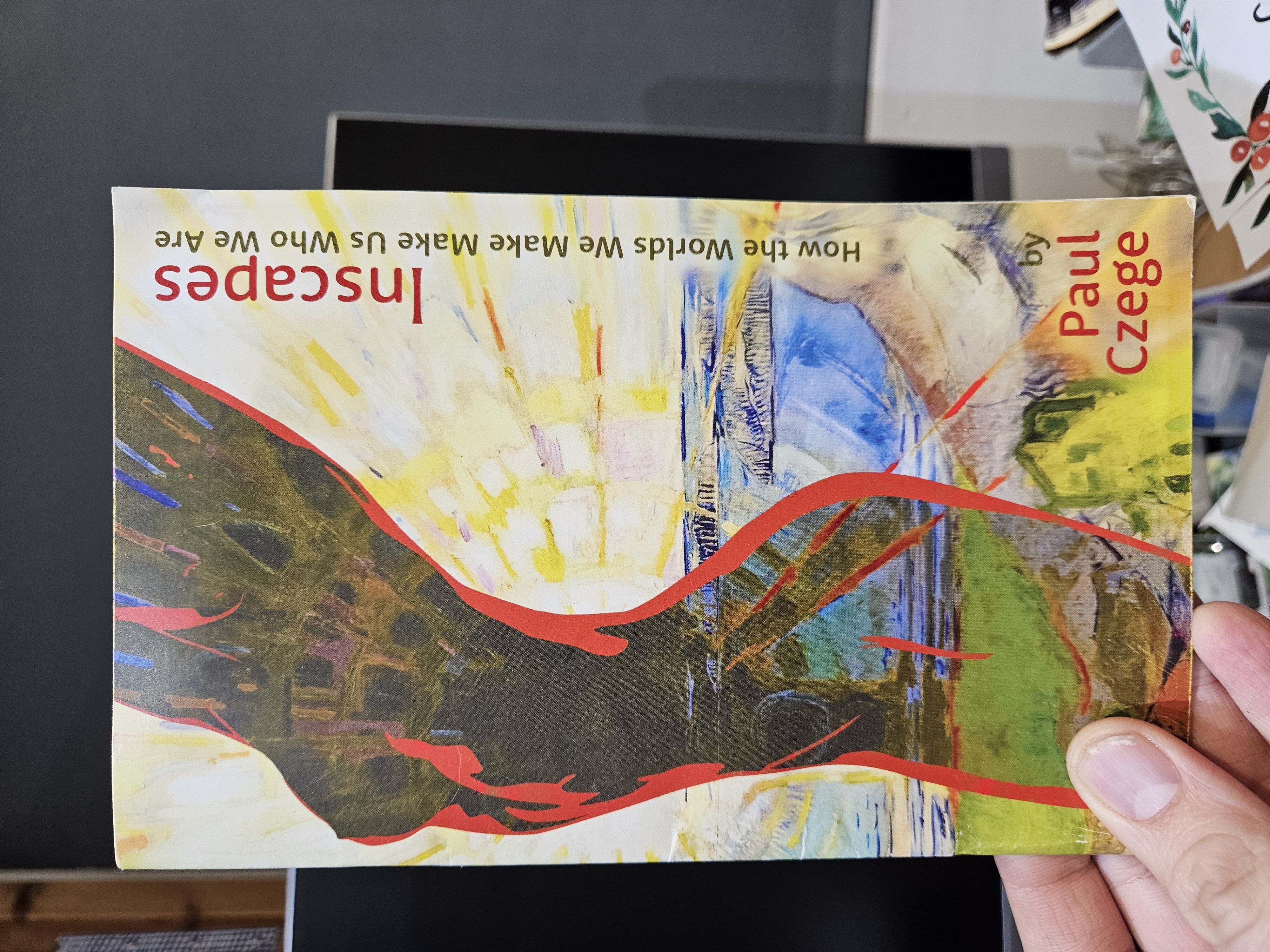
This is the physical softcover edition, a 44-page half-letter size zine with a colour cover and B&W interiors.
Why do I have this?
I've been following Paul Czege's work for a really long time. His epic The Clay That Woke was the first game I ever backed on Kickstarter, way back in 2014. It was the first TTRPG that really made me feel something just by reading it. Later, I found some of his other work really inspirational: Nicotine Girls, The World, The Flesh, and The Devil, Acts of Evil1, and others too. I interviewed him on Yes Indie'd Pod, and I've been chatting to him on and off through social media and Discord ever since. I even commissioned him to write a suit for ghostbox. So, yeah, I guess I'm a bit of a fanboi.
Anyway, that's why I backed this zine on Kickstarter earlier this year. It was an insta-back from me, just on reputation.
Level of review: Deep Dive
This is another short zine with small text blocks, so I'm gonna read the whole thing, and give you my thoughts. This review will probably be a little different to usual, because it's not a game, but it'll still be an in-depth look at the whole thing.
Vibe Check
The zine itself is half-letter so to my British eye it looks tall and slim. This really complements the cover art, which is also tall. The cover paper is a heavier paper stock, and it's a silk or a gloss coating. Either way, the colours really pop.
These zines that Czege has put put have had wonderful covers. This one is a clever reworking of a painting by Edvard Munch and sketches by Gustavo Rezende. It's a striking design, and particularly on the rear, bright and colourful.
The blurb on the rear is interesting, asking intimate questions and expressing personal thoughts:
What happens when worlds take hold in you, when you live truer narratives in them than your life in the temporal world? I learned the answer in photos that created narratives in me, from the worlds of my relationships, and with my successes and failures playing immersive journaling games.
In Inscapes I tell you what I learned.
This feels like being confided in, like there are secrets and mysteries to be divulged. I'm really into it. So, in my book, this zine has really pulled me in.
Flick-Through
This zine has art on the inside covers and I love that -- it feels really luxurious to invest that effort on these often neglected pages.
The text pages are a lightweight silk paper. It's a great choice of paper -- the zine closes flat really nicely, with no gape at the spine, but without the paper feeling too thin. Taken together with the other book structure factors, it makes the thing feel like a well-considered piece of design.
I thought the opening page was a contents page, but it's not, it's an index of themes. This feels really relevant to this particular zine, but also a technology that might be useful to TTRPG zines and books beyond. Need to know about Retconning? Check out page 13 and pages 14-15. Or, in theory, want to know about the combat system? Try pages 67-85, 102-104, and so on.
The body font is well-chosen and easy to read; there are no titles, sections being separated by fancy markers, but the page numbers (in words!) and the index page are written in a calligraphic typeface which I find a little hard to read at speed. That typeface is also used for the credits, which are comprehensive, even covering beta readers.
There are 42 text pages, and whilst the text blocks are large, they don't feel dense, being narrow and having been spaced well.
I'm mentioning a lot of design details because it's hard to have an opinion on a series of blocks of text other than surface level. If this were a book of mechanics or setting details I'd find that hard, but it isn't: it's a collection of editorial-style ideas.
That said, it's exceptionally subtle in its layout -- typesetting really -- and it's effective at getting me to want to read it. Kudos, Czege, because Inscapes is really smart in that regard.
Deep Dive
Cards on the table: I'm struggling to put a coherent response together to Inscapes. Not because I don't like it -- I do, I love it -- but instead because it's extremely out of my wheelhouse, and not just that but also that Paul Czege is without doubt the most erudite and authorial writer that I've reviewed so far. I feel a bit daunted by the task of making meaningful and useful critique here, because I don't think my own thoughts can stand up to the task. But I will do my best.
Inscapes is not a game, and it's not a """module""", and it's not really an advice book like, e.g. James D'Amato's The Ultimate RPG Gameplay Guide. It's entirely its own thing, and that makes it (at least for me) moderately difficult to approach. In many ways it's like an essay in pamphlet form, except there are several threads of discussion intertwined throughout it, which is both clever and beguiling (more on this later).
I think to summarise it glibly, I would say that this is a collection of loosely-linked thoughts about playing solo journalling games, including some episodes which are examples of play. Except these examples of play feel like someone explaining their dreams to you. Not in a bad way, though -- these are vivid, creatively written moments of play that feel considered and deliberate and as though they felt very, very real to the author.
Where The Ink That Bleeds is (at least in part) an exploration of how to play journalling games, Inscapes feels more like an exploration of how journalling games might play us. There are sequences where Czege talks about imagined authors imagining a character imagining an encounter with himself. This sounds contrived, but it's clever and intentional, and it comes from a place of intense self-reflection. In fact the entire zine is like this, which I suppose is telegraphed to me from the blurb, and indeed from the Kickstarter page.
What it also reads like is a philosophical treatise on the self and how we relate to the world around us, but approachable, like something Will Self might have written. It reminds me, weirdly, of Will Gompertz's Think Like An Artist, which is presented like a series of exercises and thought experiments. The reflective, observational, wryly humorous style really works for the points Czege wants to get across: light in tone and serious in nature, whilst superficially dealing with something whimsical.
I guess if I have a reservation it's that it gets quite, uhh, raunchy in places. I'm probably a prude when it comes to literature, and it's not explicit by any means, but there's a lot of sex in this short zine! Maybe I could have guessed that from the cover. Anyway look I'm not against it, I guess this is a content warning.
Another minor irritation: Czege does make a lot of references to The Ink That Bleeds throughout this, which I hadn't thought to read it before I read this one. But you can read it as a standalone text; I don't think it needs that scaffolding, and Czege isn't doing it to make you go out and buy it (although you should). It's just being used as shorthand for some of the more interesting concepts he's talking about.
To come back to that thread about it being both clever and beguiling: from those that have read it, I've seen a common comment about Czege's book The Clay That Woke, which is that its thorough twizzling together of the narrative and mechanical threads of play is both extremely clever, and somewhat challenging to mobilise for play. I love The Clay That Woke deeply; I've read it twice, and I've considered running it for a one-shot at least once, but I struggle to work out how to play it effectively. I have this vague categorisation of games that basically divides games into "games for non-players", "games for players", "games for GMs", and "games for designers", and The Clay That Woke falls into this latter category, because it's smart and full of amazing ideas and novel mechanics, but it requires a deep cerebral connection to the game that is impossible to attain casually.
In case you're thinking, "hey, Marx, this isn't a review of The Clay That Woke", you're right, but I'm getting to the point: Inscapes feels like that for me: it's also very smart; it's also full of amazing ideas; it's also full of things that you could bring into your own experiences of play; but it also requires a deep cerebral connection to Czege's way of thinking that (rightly) is impossible to attain casually.
This does not detract from it at all, though. This zine is full of dense text and long paragraphs, but it's not a chore to read, it's a joy. Czege's level of research2 here is very obvious: dozens of journalling games and oracles are namedropped, some of which I recognise (and, amazingly, most of which I don't), a few of which I've played, a couple of which I've spoken to the designers about, and one of which I contributed to. And these aren't casual references: it's clear that Czege has played them at least once, trying to strike a connection to them by embodying the characters and putting himself deeply into the world of the game.
That brings out some truly striking revelations about himself, about these games, and about the worlds they create and the worlds we create in ourselves. It's personal and personable and intimate; it feels like Czege telling you to do journalling games not because it's fun, but because it's good for you, helps you to develop yourself, to understand yourself better.
Yes, I know, that's the point! But it works. It sticks the landing. This zine is pulls you in, and is interesting to read.
When I got to the end of Inscapes, I felt like there were depths to this work that I don't fully understand and that I won't fully understand until I try to put them into practice. Maybe then I'll report back again.
Final Thoughts
If you're into journalling games, you should get Inscapes, as well as its companion piece The Ink That Bleeds. It's that simple.
If you're into solo games but not necessarily journalling games, I think this zine also has a lot to offer you: it might persuade you otherwise, or it might make you think about ways you can integrate journalling into other modes of solo play. In that case, I expect that The Ink That Bleeds might be more useful, but note that I haven't read it in a lot of detail.
If you're not into solo games or journalling games, but you'd like some thoughts from a designer and author on ways to play with characters, worlds, the fourth wall, and your own personal internal thoughts, I think this is a really interesting zine that you won't regret purchasing. I found it fascinating, intriguing, and -- like I said before -- beguiling in equal measure.
In short, I think Paul Czege has produced another banger, and any money and attention sent his direction for this is well worth it.