Jude's World, by Yvris Burke
What is this?
Jude's World is a game about a preteen called Jude trying to stop their parents' imminent divorce and dealing with preteen stuff. It's a short zine, containing the full game and a bunch of random tables, written by Yvris Burke and published by Button Kin Games in late 2024.
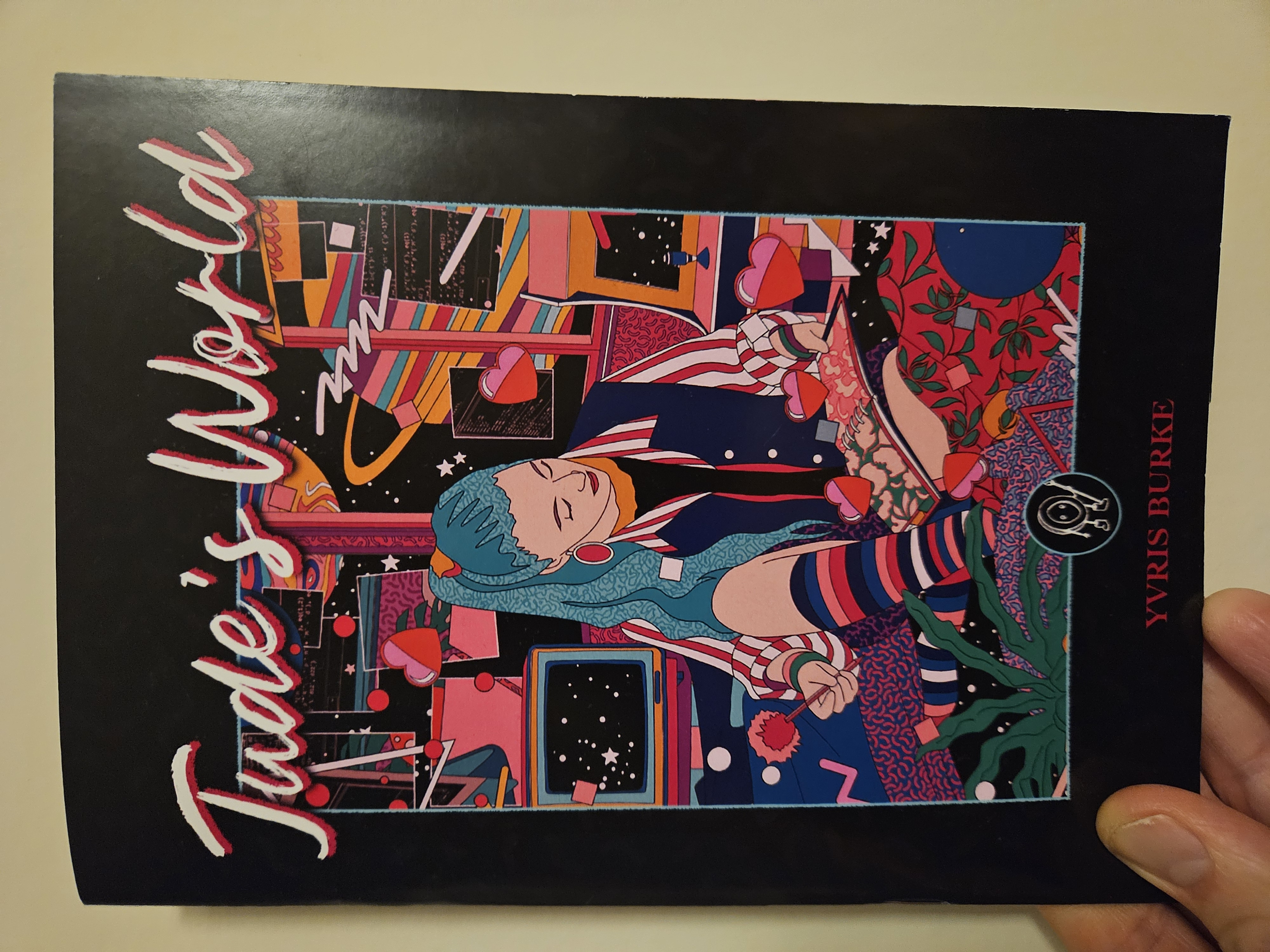
I've got the physical, softcover zine edition, which I got in early December 2024 after backing the Kickstarter campaign earlier in the year.
Why do I have this?
Button Kin Games are in the UK TIN Discord server, so I'm in fairly regular conversation with them. When Jude's World came up on Kickstarter, I was immediately attracted to the beautiful art, the game's concept, and the layout previews I was seeing (more on this later). I'm not sure it would have come across my feeds otherwise -- I don't remember seeing it advertised much on BlueSky or in my other servers -- but I'm certainly very pleased it did.
Level of review: Deep Dive
This is a short zine, so I can read through the entire thing. As a solo journalling game with tarot cards, I'd be really interested to try it out later, so I might get to come back to this one with a playthrough in the future.
Vibe Check
Jude's World has a really striking cover: it's colourful, in lines and solid shading. The central image, by artist Mega Asellia, is of a preteen femme-presenting person surrounded by what I perceive to be very 90s ephemera, not to mention title fonts, and it's surrounded by the kind of thick patterned border that I really associate with stationery of that era. As a (fellow?) child of the 90s, this is extremely appealing.
The art reminds me of a few things, including the clean sharp lines of, say Jet Set Radio, and a kind of modern art style that you see in a lot of British comic artists. It also reminds me of The Tarot Del Fuego, which is bold and colourful and full of decoration. I'd be very drawn to it on a stall or in a shop; on the internet, I think thumbnails and smaller images on dark backgrounds might not do it justice.
The blurb on the back is detailed, describing a story of transitioning from childhood to teenhood, whilst dealing with (and fighting back against) parental separation. This isn't a story I've personally experienced, and in fact almost none of my childhood friends experienced divorce or separation when I knew them, so I can't speak to that so much, but naturally I have been an awkward preteen (and indeed I will have several of them over the next few years), and reminiscing on that might be cathartic, or indeed useful, to me.
It's also not a story I've seen in a roleplaying game before -- I suppose games like Girl Underground or Heroine look at these from a more fantasy perspective, but the more normal look at this isn't something I've seen. That said, I did write a core playset for Little Katy's Tea Party, a game which explicitly looks at transitioning from childhood to teenhood, but not from a first-person perspective.
At any rate, the zine is appealing and intriguing, and I'm really interested to find out more.
Flick-Through
The zine is short -- 27 text pages with light card covers. Credits are on the inside front cover, which is always nice to see, and there's a fair number of well-laid out tables towards the back, so the actual body of the game is very concise. The game is written and laid out by Burke, the cover art is by Mega Asellia as previously mentioned, and the proofreading was by George Bickers. There's a big list of sponsors and playtesters too.
The text paper is a good weight, but the covers are a bit thick, so they pull the zine into a bit of a gape in the middle, and the staples aren't quite flush with the page, which might mean that the zine won't withstand being used over and over again. That said, it's very well made, and the attention to detail is otherwise good -- the staples are even coloured to match the cover, which is a great touch on a staple-bound zine.
Burke shared some layout images of the game as it was being developed, and this filled me with the warmest kind of nostalgia, because it was being made to look like a 90s FunFax organiser. This is definitely one of the most UK 90s things I can think of; my older sister had one, I had a (slightly different) one, my friends had them. It's there throughout as faux elements: tabbed dividers, wire binding, lined paper, chunky motifs and logos. The fonts are on point too, and have been chosen and sized carefully and appropriately for the text. In short, Burke's layout perfectly matches the theme of the book (it's only slightly annoying that the dividers can't actually be used).
This is another short zine with a very thorough contents page! This is pleasing, but something which perhaps goes into too much detail, too many levels; I do feel a bit on the fence about contents pages in zines, because I'm always thinking of what my first (game) editor said to me about short games: "Perfect information transfer doesn't exist!" In a big book, a solid table of contents is fantastic for the purposes of reference, but this is a simple game, and flicking through to find what you're looking for probably wouldn't even take as much time as going to the contents page of Burning Wheel, looking up the chapter, and then flicking through that chapter to find the rule you're after. I don't know if I feel as strongly about it as maybe the above suggests, and in other reviews I've praised the contents pages, but I do think that maybe here it is overkill? I'm not sure.
While I remember, because it's not really quite in deep-dive territory: There's an example of play running throughout the book, in-line, which is italicised so it stands out from the body of the text -- it works really well.
Deep Dive
Burke has put together a great game here -- from the moment you start reading, you understand where the game is coming from and what to do with it. It tells you, in no uncertain terms, that the films on which it is based (both versions of The Parent Trap) are flawed in many ways. But Burke goes on to explain (or at least postulate) that the reason they are flawed is that they are told from the point of view of the protagonists: preteens with little to no understanding of adult relationships.
I think this is key to understanding what Jude's World is about: it's about successfully making the transition from being a kid, naive and more or less carefree, to being a teenager, with a rapidly developing understanding of the adult world. To me, it talks about coming to terms with situations over which you have no control, like growing up, or your parents separating. That's a topic that players of all ages can stand to get to grips with, and it's told through a lens that we all experienced (to some extent).
If this is Burke's intent, then it's both subtly and masterfully achieved, because the book itself is, as I said, only 27 text pages. But achieved it is: I came away from it thinking about situations over which I have no control (a great many of them), and what I can do as a person to change them (very little), and what I should do as a person to come to terms with them (a whole lot more).
Another thing Burke has done really well is to put the scaffolding in place to make players feel comfortable: characters are ungendered, player comfort is put in the centre, the reasons for parental separation are basically ignored in the text, and the examples and samples are well-considered and diverse. It's not in-your-face about it; diversity and queer inclusion is simply a matter of fact in Jude's World. Given the implied setting of the UK in the 1990s, with Section 28 thoroughly preventing discussion of LGBTQ issues with young people, this is a refreshing change, and a welcome one.
The game uses tarot mechanics with a delightful setup (Building a Life) where you make a guided tarot spread that looks like a little house. This is both very cute and extremely on-point, a very neat elision of mechanics and theme. As the game progresses, you Rebuild a Life by placing used cards back into this spread, which is a clever way to mirror the setup phase, and to follow what's happening in Jude's life.
If there's a flaw in this part of the game, it's that there's no epilogue part of the game where you re-interpret the Rebuilt spread. I feel like this would add some additional closure to a game that otherwise feels well-contained. You could, of course, do this yourself -- but it would have been nice to include in the rules themselves.
The game loop also sees you tracking Hearts and Hurts for your parents' relationship as you spring traps on them to try to get them back together. Traps being sprung use a PbtA-style dice roll, which pushes forward the narrative and adds to these tracks. This resource planning system is quite clever, and has a fail state which phenomenally sets back the progress of Jude's overarching plan to get their parents back together. I did wonder whether the "win" state was unattainable, like the win state in Chris Bissette's The Wretched, i.e. by design, although without playing it a few times it's hard to be sure. If that's the case, then it's another example of how this design reinforces the feeling of being out of control, and coming to terms with that.
There's a kind of "equipment" loop which sees you collecting keepsakes, accomplices, and foils to use in your traps. You draw these from a deck of cards, drawing three per turn and discarding one, and then use them as you need to; the reference tables for each are very evocatively written, and it was impressive (read: concerning?) how many of the suggested keepsakes I had in my house for my own relationship. This is a great strength of card-based games: the many ways you can use the cards to remember things, and Burke has used this to great advantage in Jude's World.
A bit that felt a little off to me is that it's uncertain whether side characters will be foils or accomplices until the last moment. I don't love this as a design feature, because although it does introduce an element of uncertainty to them, it also takes away from the narrative agency you have over these characters. I'd like to be able to say "oh, my friend Davey helped me out in the this situation because he always does" rather than it transpiring that in fact he's working against me. But perhaps this is again Burke reinforcing that unspoken theme, and if that's the case then it's managed to break the fourth wall and make me indignant even outside of play.
The last bit of the puzzle is the Twists mechanic and how that interplays with the Traps. In each round you can spring a trap or play a twist, which is an important event in the life of a preteen. In either case, you play the card into the Rebuild spread, meaning that having a preteen memory means you lose an opportunity to bring your parents back together. This is fantastic stuff: it really forces you to choose between your personal wellbeing and that of people around you.
This choice between your personal stability and growth as a person, and temporarily stopping your parents from ending their relationship, is very much at the core of what I think Burke is saying with Jude's World: the naivety of youth versus the pragmatism of adulthood. It brings to attention the importance of this transition for kids: no longer demanding attention, but not yet taken seriously; wanting to hold onto stability, and wanting to embrace change.
For those of us with kids in that age group, which I basically am, I think this is an important lesson, and one I'll try to hold onto by, y'know, actually playing the game and channelling my inner preteen.
Final Thoughts
Burke has done a great job with Jude's World. Here's a neat little game which you could easily pick up and play with almost no roleplaying experience, and use it to tell a story where you're both the protagonist and a side character in equal measure. Its setting and theming implies a really rich vein of story relevant to everybody, it does clever things with theme and mechanics, and it uses card mechanics really smartly.
I think you'll love this game if you like cozy, slice-of-life games, or if you want a solo experience where you really channel a character that you're probably a little estranged from. If you have kids or know kids of this age group, then I also think you'll get a lot out of it.
If you don't like journalling, I think this game would lose only a little of its strengths by removing that aspect; the link of theme and mechanic is clever enough to carry it most of the way, but preteens writing diaries and journals is a strong implied part of the setting, and it's also really fun, so please do consider writing things down.
On the other hand, if you're after something less rooted in reality, then this probably isn't the game for you. Although you could reskin it, it feels strongly linked to a particular moment in social history, and adding specfic or fantastical elements to it might detract from the transitionary ideas embedded in the game.
For me, Jude's World is a really strong game, a fruitful void for interesting play. I'll definitely be playing this game in the future, so please watch this space for an updated version with a playthrough section.