Lo! Thy Dread Empire, by Tanya Floaker
What is this?
Lo! Thy Dread Empire is a hybrid tactical RPG and narrative wargame by Tanya Floaker and artist Julia Nevalainen. It's a game of fighting back against the (literal) death cults of capitalism as the (literal) embodiments of the bogeymen of the culture wars.
I guess it is to Trump what Warhammer is to Thatcher? Perhaps that's a glib summary, but it's how I remember it.
Why do I have this?
Floaker was an early guest on Yes Indie'd Pod and I interviewed them for games in three episodes overall: this, Be Seeing You, and the Edinburgh Indie Games Club zine. I'm really interested in their work, and backed this during its campaign on the strength of the really cool art and the clever concept, even though it's very far out of my normal wheelhouse1.
After backing it some two years back, I've finally received the physical version, which is an A5ish hardcover book which came with two posters and a play aid. It's a really nice edition!
Level of Review: Deep Dive
I am going to read and review this entire book, which is 80+ pages of reasonable text with a lot of art and tables, but I'll caveat it by saying that I do not play wargames, and haven't done since I were a wee lad. There's a reason for that: I suck at wargames. I can't paint for toffee, I never had enough money for the minis anyway, and to top it off, understanding strategy is a personal weakness. Given that I grew up in Nottingham, the home of Games Workshop and therefore probably (what was) the beating heart of the industry in the 1990s, this is a personal failing2.
Vibe Check
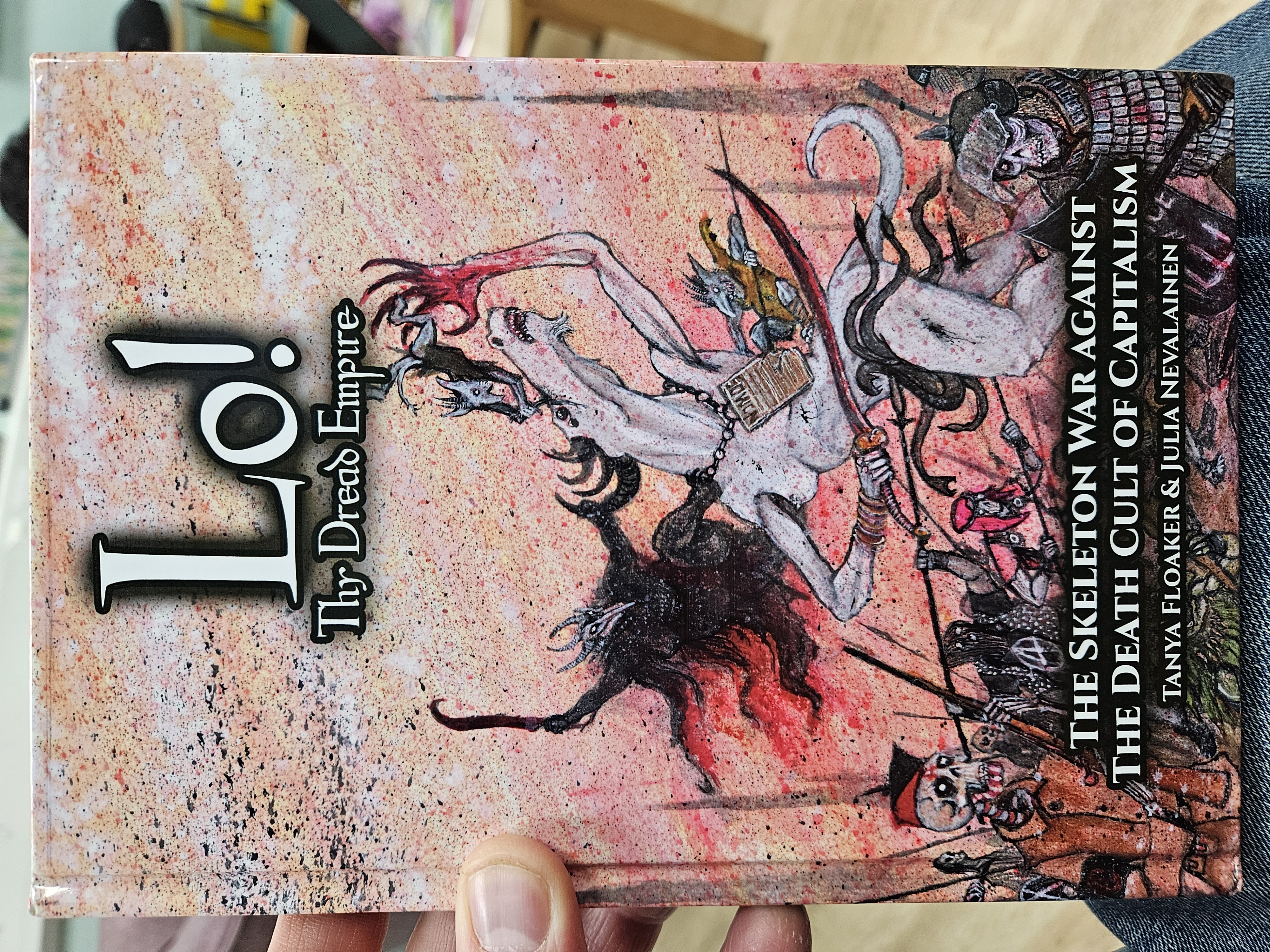
The cover for this book absolutely kicks ass. Nevalainen's art, a horse-headed, rapier-wielding naked figure fighting armoured skeleton warriors, is striking and beguiling; it continues on the back, where the little flute-playing bone-masked gremlins raise more questions than they answer. The title makes me want to know more, and the subtitle ("The Skeleton War Against The Death Cult of Capitalism") is -- well, who doesn't want those things. This is such an effective use of art and typography, and it's captivating.
The back has no blurb and instead just lists the basic requirements for the game: narrative wargame and tactical RPG; two players minimum; 1-2 hours playtime; token-based bidding mechanics; miniatures and GM both optional. With a bit of a bumsteer, I think you can see what Floaker's work is all about here, and a little bit as to the ludography of this game.
In short, as with Floaker's original pitch to me and the Kickstarter page as it existed all those years ago, this is a vibe I immediately gelled with and needed more of in my life.
Flick-Through
Lo! Thy Dread Empire is, as the credits page tells me, entirely the work of Floaker and Nevalainen; the afterword lists a few more people on either side, but for such a small team, this is a fantastic achievement. Every page has an illustration or a full-colour, swirly, splattery background painted by Nevalainen, which gives it the feeling of a Warhammer 40,000 codex3.
The body text is big and highly readable, with capitalisation and bold face for game terms. The header typeface is a good choice but needs the size it has to be readable; any smaller and it would feel hard to read. Most information is presented in simple structures; there are a lot of tables for factions and units which are quite a bit harder to read because tags are long and cells are small.
As a side note, the production quality on this book is great. It's hardcover with a shiny, full-colour cover full of Nevalainen's muted palette with sharp highlights (this is a bleak colour scheme). Inside, Floaker has chosen black endpapers, which looks great against the text layout. The text block is in medium-weight satin (maybe gloss) which is exactly the right choice to make the colours pop and the pages to feel crisp.
Deep Dive
Because of Floaker's typography choices, as well as the large number of full page illustrations, what could have been a daunting 86 pages (as listed in the contents) actually feels much shorter in the reading. Information is presented neatly and concisely; for me, it flows well and is easy to read.
Floaker's "commitment to the bit" is readily apparent in Lo! Thy Dread Empire. Within a couple of pages of the front matter we're presented with a few things that really get across their point: there's a version of the (somewhat famous) Olivia Hill Rule to let fascists know they're not welcome (always good to see), and there's a discussion on what a Friendly Game should be. This last bit, which flies against what I feel like wargames typically feel like (after all, I've been a teenage boy playing WH40k against other teenage boys), sets this game up to be a collaborative experience where the principle aim is to have fun and tell a compelling narrative. Like a roleplaying game, amiright? Something that readers of this blog will be familiar with. I'm not sure how common this kind of friendly game setup is with the wargames crowd, but it feels useful and honestly a fantastic inclusion.
Floaker's vision here is presented efficiently and quickly, with one half page dedicated to introductory background material, followed by 11 spreads (some only half-spreads) of large text rules material. The system itself is diceless, being based on the spending of power tokens in a way that shares DNA with Dream Askew. In this case, diceless doesn't mean "narrative SJW circle-jerk", but instead something closer to my experience of Lords of Gossamer and Shadow: a medium level of crunch, a reasonable level of technical complexity, and a lot of inter-player negotiation and mediation to resolve conflict. This is not a criticism, and in fact I think a lot of tactical RPGs could stand to learn from what Floaker puts together here, but based on my (admittedly very limited) understanding of wargames, this feels like a challenge to manage, even given the "Friendly Game" formulation.
Nonetheless, I love the rules here, because they feel just complicated enough to allow for emergent play, where mechanics interact to produce new and interesting effects. The fact that everything is based on negotiating whether narrative tags apply or deciding how much of your power resource to invest makes it interesting, and gives it the feel of a roleplaying game rather than a wargame. That's very cool. The example of conflict, although short, gets the point across succinctly in its final point: "Allies narrate the outcome." Destroying your opponents isn't what's important (to Floaker); what's important is taking narrative control from them. It's a subtle difference which I think pins the whole thing much closer to a PbtA philosophy than a wargames one4.
There's also an entire set of mechanics around planning: units can't act contrary to their understanding of the plan, and they can only be told what the plan is in certain circumstances (usually when they're near to the general), which is something that feels really cool. I don't know how uncommon these rules are in non-Warhammer games, but to my untrained eye they feel pretty fresh5.
Floaker also presents some long-term campaign play mechanics, which are telegraphed early on. I think this encapsulates a lot of the more or less original mechanics here: experience is more about adding textual sentences to their territory descriptions, which is how orders work too, and it's more or less like tags as well. To misquote James Carville, "it's the narrative, stupid." As a fan of Paul Czege's The World, The Flesh, and The Devil, this idea of acting on the textual rather than abstract statistics is very appealing.
If there's one thing I'm feeling is a bit underbaked, it's the page about playing with a game master, something which I think sounds very interesting from a wargames perspective, but something that I feel Floaker's heart isn't really in. Personally, I'd rather have this not included at all, or expanded into an entire mini-supplement. That said, it's not enough to put me off entirely.
The absolute powerhouse of this entire game is contained in the expansive faction lists at the back of the rules texts. In this, we see exactly what Floaker and Nevalainen have in mind. These are presented in a set structure that make it really easy to build your little warband of absolute freaks: full page banner art, flavour text, some inspirational picklists and touchstones, the list of units, and then a beautiful spread of Nevalainen's art with a quote to represent the faction. These factions are arch, witty, and bitterly acidic: even just the first (The Death Cults of Capitalism) gives Henry fucking Kissinger as its general, with Yuppies and Red-Pilled Berserkers listed as other available units. Floaker continually takes their ideas and hits us over the head with them. I laughed, I cried, I sucked my teeth, and I asked for more. If the name doesn't give away their ideas, the tags do; literally my only complaint is that compared to the other text they're harder to read.
Everything about these factions is, in short, very good; I like the in-jokes I get, and I like that there's ones I don't get. I started putting together a list of some of my personal favourites, but it was just everything? Instead I'll just say that Saint Die'n'Awe, Paragon of Purity, caused me enough mirth for my partner to come in and ask if I was okay. Unfortunately I couldn't reproduce the effect without the context.
Final Thoughts
I loved reading this: Floaker's work is always arresting, heart-stopping stuff, and this is no exception. In some ways it feels like fanfic or fan service, but the fans in question are punks and anarchists, and the service reminding them what they're up against. Maybe some people from punk scenes beyond these hallowed shores won't get all of the jokes, but I might be okay with that. It's always good to push back against the US cultural hegemony.
Nevalainen's art really makes these sing, and I'm so glad that there's so very much of it. It's scary, threatening, and also funny. There are visual gags that I'm pretty sure I don't get, just like in the text. The style is at once colourful, bleak, and disturbing. It's a joy to look at. I simultaneously want and don't want these pieces on my walls.
The real question for me is: would I play this? and I don't think that I can answer yes, because it's well beyond what I could bring to a group or table at a con. But that doesn't mean that you shouldn't. This game reads like a great game, and it feels like one, and Floaker as always has made it freely available as a PDF.
But if you can, you should buy it. Partly because it's really beautiful to look at and flick through, partly because it feels like it would be really interesting to play straight, and partly because if you buy games like this then creators like Floaker and Nevalainen will make more of them. And the world probably needs that right now.
Since I worked out at the age of 18 that I suck at every aspect of them, I don't play wargames anymore, but they'll always have a special place in my heart because I'm a British nerd, so if you cut me I bleed Blood Red Citadel paint.↩
That said, when I was playing Warhammer I a) got super into the lore (who would have guessed); and b) discovered two neat little games: Necromunda, which is a gang-scale skirmish game in the 40k universe, which has a lot more narrative styling, and Inquisitor, which is a full minis roleplaying game. Practically speaking, the rest of my history in RPGs writes itself.↩
Works which certainly had much bigger teams, and significantly higher budgets.↩
The elephant in the room is, I suppose, the [https://www.revenant-quill.com/p/free-kriegsspiel-roleplaying.html](Free Kriegsspiel Revolution) style of wargames and later roleplaying games, which is significantly older than most people expect, and in fact is much closer to this kind of thing. Except with lead miniatures of Napeolonic warriors rather than skeletons in the war against capitalist death cults.↩
Please contradict me if I'm wrong.↩