Nice Monsters and Scary Sprites, by Barak Blackburn
What is this?
Nice Monsters and Scary Sprites is a short TTRPG in the story games tradition written by Barak Blackburn & Ellie Hillis, with Aaron Howard, and published by Density Media. I've struggled to find many references to it online except for where it's been sold, which includes Noble Knight Games if you're looking to pick it up.
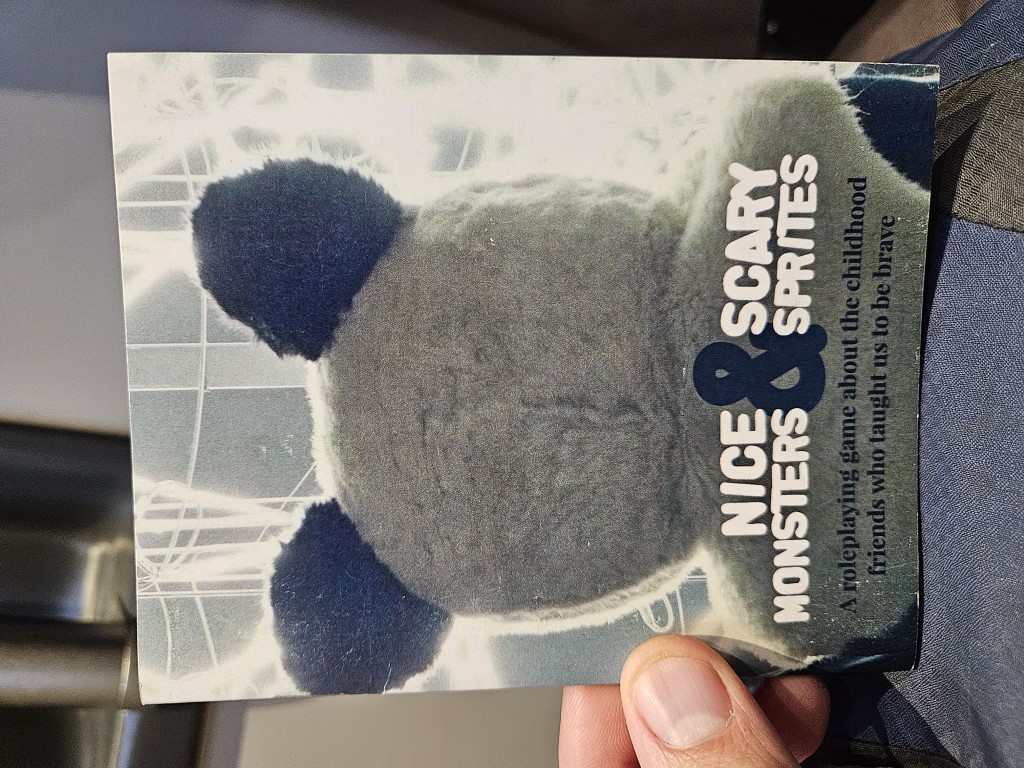
This is a short zine that I don't have tonnes to say about, so let's dive right in.
Why do I have this?
Premier UK game store Leisure Games regularly sell off TTRPGs for cheap, so whenever I buy something from them I add in something from their sales category to bring the price up to the free delivery threshold. This zine was one such purchase. I've got no other connections to it, and in fact I can't find many references to it at all on the internet, other than its name seems to be a rehash of Scary Monsters and Nice Sprites, which is a mashup album by Skrillex, the name of which is itself a rehash of a David Bowie album.
Level of review: Deep Dive
This is a really short zine in a small format, and whilst the text was sort of dense, it didn't take me very long to read. Having quite thoroughly read it and flicked back and forth to check I understood some of the nuances of the rules, I feel like I can manage a deep dive. I haven't played it, though, and to be honest (read the rest of the review though) I think I'm very unlikely to do so.
Be aware that there's a twist in this game that I think is pretty crucial to my review. If you're planning to play it, then you might want to avoid everything the Deep Dive section.
Vibe Check
Firstly, this is a really tiny zine. It's just smaller than A6, small enough to fit in a coat pocket. It's also pretty short, at 32 text pages (a bunch of these are reference pages too). The front cover image of a stuffed toy panda is quite sweet, but doesn't give a huge amount away. There's no blurb on the back, although there is on the first text page – "A roleplaying game about the childhood friends who taught us to be brave." Likewise on the final text page, there's a pretty decent introduction to the game, including some hints about "secrets" and "a twist", which is a strong hint of what's to come.
I think usually I do the staff role here, so: the authors are listed as Barak Blackburn & Ellie Hillis, with Aaron Howard (I can't find Aaron except in reference to Density Media). There's no credit for layout or illustration, except that "graphic design help" came from Generic Mike, which is a really funny moniker that's basically impossible to Google.
Flick-Through
Whilst the (nice, thick, gloss card) covers have a teeny-weeny-itsy-bitsy little bit of colour, the (flimsy, thin, uncoated paper) text pages themselves are all black & white. This is no shade on the design; it's pretty slick, and it's obvious that the typography has been done by people who think logically about how text should be presented. This includes things like visually distinguishing which pages non-GMs shouldn't read (important here), and presenting important game terms simply and obviously (also important; for a small game, it packs a lot of mechanics in).
All of the art is photography, which is really nice. The ones with credits are on Creative Commons licenses, and there's a bunch of others with no credits; I imagine some of these were taken by the authors, and some are public domain images.
As an aside, using photography in games is really underrated, IMHO, especially for this kind of "real world" game: it's cheap or free, it's better than no art, it's often better than bad art, and there's usually a lot to choose from. Pro tip from Marx: If you're producing a zine on the cheap, then definitely consider photography for artwork.
Deep Dive
Thematically, this is a game about "Sprites", childhood guardians in the form of cuddly toys we love, or imaginary friends, or TV characters we really imagine as being with us. It's about what they can teach us, and about how we learn to live without them. This seems simultaneously a pithy choice of subject, and a lofty goal: what does it mean to grow up? It's a really interesting lens to look at how children become adults, and then possibly how adults can hearken back to childhood.
Does it do this perfectly? No, but it's also only 32 pages of text, a lot of which is images. In play, I imagine it probably works quite well to bring up some childish emotions. Not all of this is the kind of cathartic, nostalgic way that the designers intended, though.
Mechanically, and as previously alluded to, this is pretty weighty. You can tell this from the first page, which asks you to gather 8d4, 7d6, 6d8, 5d10, and 4d12 per player, plus tokens for the GM to hand out. Later it also says that players need tokens (this should have been on this first page). This is, I would say, NM&SS's first misstep: what the actual bleep. This is a serious set of dice you need. Other than people with a really serious dice collecting habit, who has that many polyhedral dice1. Were I editing this, I would strongly suggest that players use a dice rolling app.
Character creation brings this unexpected crunchiness home: it's in two parts, one for the PC, and one for their Sprite. Each has a point-buy system (thankfully the same economy, if different scales) for the three Traits: Heart (relationships to others); Heroism (physical stuff); and Hope (mental stuff, confusingly). You also get to make a "wild card" ability, which gets activated at certain times in play.
Once you've done that, you have to derive the Traits' dice pools are, based on the PC and Sprite Traits. This is fairly confusing, but there's a reference table to make it easier. The dice pools also have thresholds for successes which change depending on the die size.
Confused yet? It gets more complicated. The rolls, which nominally look quite simple (roll the dice pool, count values over the Threshold) can be modified by several things: your Health, an arbitrary difficulty score, whether a Wild Card is being used, etc. The results are also fairly complicated, being able to be hits, misses, near misses, complete failures, blah blah blah. Perhaps it would come naturally to you, but for a one-shot game there's a lot of rules. You'd have to be rolling a lot to learn it quickly. This might be your play style, but it's not mine.
By the time I get to Difficulty and Challenges, which is how the GM makes things even tougher for the players, I've come to the conclusion that the author is a fairly adversarial GM, and I'm just not that interested in that kind of game. If this were billed to me differently, like a very low-stakes character investment game like Dungeon Crawl Classics or Mörk Borg, maybe the adversial GM trope is funny, but here where I've spent gods-know-how-long making two characters and deriving a dice pool for them, I'm just not that into it.
Once we're done telling players how to roll dice (and neatly avoiding any indication of how you're supposed to play the game, incidentally), we get onto the secret GM section.
Here's the spoiler-ey section, if you're trying to avoid it.
The scenario presented in the game sees you trying to rescue the Sprites, who have all gone missing. "The crux of the game" is that the players can actually do nothing to stop this from happening. Your character wakes up and sees their Sprite disappear or be destroyed. Then, you band together and set off to defeat the evil that's taking the Sprites out of the world.
In general, folks, I'm really against this kind of bait-and-switch twist in roleplaying games, because it causes bad feelings in a lot of people. If a GM did this to me, I would politely stand up and walk away. I've gone through the rules to make characters on the idea that I get to use that character in the way I expect; and now, you're telling me I don't. You've changed the social contract of play. This, umm, sucks. For me, it's like setting up to play Uno and then finding out we're actually playing Monopoly Go. It's bad GM-ship, frankly.
Even if you were to tell your players in advance, I would still be hesitant here, because it's very railroad-y. Lords know I hate railroads. I just don't like the premise of the game. Maybe if this was a longer-style game, the payoff of having one or two scenarios with your Sprite, then finding them gone one day – maybe that would feel better. But the way this is presented, as if you sit down (potentially with a bunch of strangers) and ask them to be vulnerable in real-time, is kinda shitty.
Here end the spoiler-ey section.
There is a modicum of advice in this GM section as to how to build a BBEG and an effective scenario, but it's nothing groundbreaking. The sample villains are also fine, if a little bland. They are at least consistent with the intended adult/children dark fantasy vibe of the game.
Right at the back of the book is a list of suggested media and influences, which includes Mr. T, Mister Rogers, My Little Pony, and Toy Story. I would potentially have put this further up the text, to be honest, because I didn't quite get the vibe until I looked at this list, and I very nearly completely gave up with it.
Final Thoughts
I think you've probably gotten my opinion of Nice Monsters & Scary Sprites by now, and it's not a positive one. But let's do our feedback sandwich thing.
Firstly, the layout and photography here is really good, and it makes for a good publication. I like the tiny form factor (it would have been stranger as a bigger format, I think), and it's well-written and well-edited (always a bonus).
Unfortunately, it doesn't feel well-designed. The mechanics are weighty for what should be a simple story game, and the twist is cruel and unnecessary – if your players have a hard time with betrayal, don't spring this on them, and please don't take it to a con. Also, there's a pretty high chance of lethal engagement here; if your players aren't used to characters dying or bowing out, then tread carefully. It's not for everyone.
On the other hand, this is a pretty innovative kind of game. I don't think I've seen a bait-and-switch so clearly codified as this, and I don't think I've seen the dice pool mechanics before. The narrative space of "how do we become adults" is a really interesting fruitful void – maybe even a narrative "liminal space" – and I'd be interested to see other games that play with this theme.
Just ... maybe not this one.
Actually, from my 7th Sea first edition days, I do have probably close to fifty d10s. But as for the others, absolutely not.↩