Not Yet, by Taylor Navarro and Poorna M.
What is this?
Not Yet, by Taylor Navarro and Poorna M., is a duet game about love, near-misses, and destiny. It's a game that feels like a romantic comedy in the vein of a Richard Curtis film, and, unlike an actual Richard Curtis film, it's actually really good.
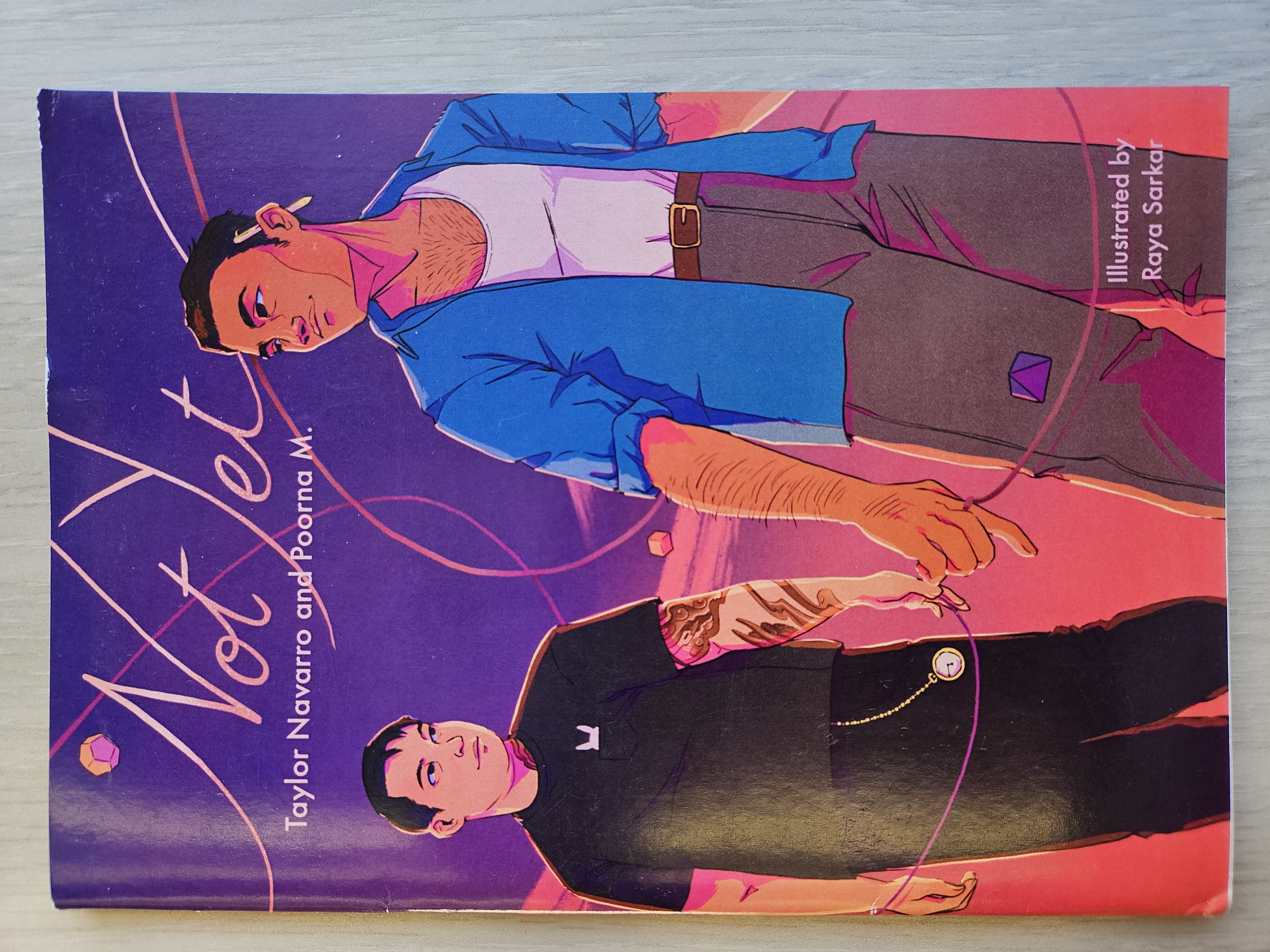
This game packs a lot into a short zine, so let's dive right in!
Why do I have this?
I backed the Kickstarter campaign for this game when it originally went out, partly because I was connected to Navarro through the UK Tabletop Industry Network, and partly because Poorna M. and I had collaborated on the (failed) Afterwords: The Far Horizons Guide to Death campaign. I've got the zine edition, which is an A5 softcover which I believe was printed in India.
Level of review: Deep Dive
This is a short game that I managed to read in its entirety on one 25 minute train commute. The joys of a small book.
Vibe Check
The zine itself is bound in thick glossy paper that gives it a kind of greetings-card vibe, particularly combined with the bold, vibrant colours and shapes of Raya Sarkar's cover illustration. The cover image (see above) is really evocative of that kind of epic/not-epic love story (it's just two people catching each other's eye, very cute), and that, alongside the wispy handwriting that forms the title, gives you a strong impression of what you should expect from the book. It's good, y'all.
The back is very simple, just words over a colour gradient. I really appreciate the targeted requirements list here: "2 players, no Game Master; Gameplay lasts 1-2 hours". There's a simple blurb that gets the point across – no need to over-complicate it, as it's a simple concept that's easy to get across: "Roll the dice of Fate and tell the story of how two people find one another." This is how you do back covers effectively, so big shoutout to layout designer Poorna M.
Other people credited include editor Armaan Babu, and audiobook narration from none other than Aaron Catano-Saez, who probably needs no introduction to indie TTRPG fans1. Just going to say it: really nice to see a shout-out to the audiobook version from the text version.
Flick-Through
Like I said, this is a short zine, just the cover and fourteen internal pages. The text pages are thick and glossy too, which makes it feel really nice and weighty in the hands (big plus from me).
Going back to Poorna M.'s layout: it's very effective. There's no internal illustration, so the presentation of the text is really important, and she smashes it. It's smart, targeted, and simple. She uses bold colours throughout to highlight headings and sidebars, and very clear sans typefaces (no fancy but unreadable fonts here, folks). This makes it easy to read, and easy to find what I'm looking for, which is essentially all I really want from layout of a small zine. Take note, zine layout designers!
A side note here: the inclusion of an entire page (out of 13 text pages!) of comments about safety and comfort is an absolute credit to both of the authors, as this has been very well-considered.
Deep Dive
This is a simple story game about destined meetings with a love interest, and it does what it sets out to do very well. It's structured around scenes where you can either straight up meet your maybe-beloved, or just miss them; whether you meet them or not depends on dice, which reduce in size with each scene: you roll, determine the mechanical outcome and "initiative", and then narrate the scene2. After a series of these "build-up scenes", the Finale scene is purely roleplayed, although the authors provide a neat little table of tropes that you can build the scene on top of.
This structure really sets things up very well to make your duet game feel like a romantic comedy; this is basically how hallmark films are structured, after all. You could easily bend this to fit an established setting, if you want to add a romantic interlude to another campaign, or of course you can play it as a standalone game.
The rules themselves feel designed to inflict on the players the kind of slightly contrived friction that fate introduces onto this kind of love story. In fairness, I prefer this to the endless "will-they-won't-they" that long-running sitcoms tend to force characters into. To actually meet face-to-face in a scene, your roll has to match dead-on; this is much harder when you're rolling d12s at the start of the game, but gets easier throughout the build-up scenes (d10, d8, d6, and finally d4), and of course in the finale you Just Meet (for better or for worse). To be clear, I'm saying this is good design; despite its apparent simplicity, the crunchiness added by the Determination tags (meta-level character traits) and the Token, both of which can be used to slightly tilt the odds (or, possibly, against!) your favour mean that you can easily create a fun and engaging story with your foil.
Just building on this: the format here (a duet game, specifically for two people) is delightful, and more games should be written in this format, because it's extremely approachable for people who want to introduce others to the hobby. It's particularly nice that it's a romantic game, like Alex Roberts's Starcrossed or Emily Care Boss's Breaking the Ice; I can imagine people introducing their romantic partners to roleplaying games through any of these three romantic-themed duet games. There are others3!
Navarro and Poorna M. have provided a very good running example throughout the zine, which helps to establish the feel of the game, and how to play effectively. There's some very decent advice throughout on how to roleplay scenes, including a rather neat idea of "too complex; didn't roleplay" to gloss over problems where you have too many threads to resolve (a common sticking point in even light story games like this).
The other great thing that they've provided is a series of tables giving examples of places you can have scenes, and complications that might happen in them. Four different stages of life are catered for (childhood, early teens, late teens, and adulthood), which would give you ideas for loads of different replay stories, and of course you can decide your own.
The one table I felt was a bit flat was the table of suggestions for Tokens. Whilst the authors say, oh yeah of course, make your own up if you like, if you provide a table it will get used, and I really didn't gel with any of the ideas presented. I might personally have just not included this table, and just provide the best ideas within it as examples in the text.
I don't want to end on a bad note, and I couldn't think of a better place to put this, so: throughout the book, in the whitespace around the rules text, are little handwritten notes, names, and initials within hearts. These are high-level Kickstarter rewards. It was very clever to include this in this way, and it's also incredibly cute. Massive, massive kudos to the elision of substance and style here.
Final Thoughts
Not Yet is a brilliantly written, well-considered, and beautifully presented game, and I think it deserves your attention.
I'm personally going to struggle to find somebody to play it with, but if I get that opportunity to play a romantic duet game with somebody, this will be one I suggest.
If you've got that opportunity to play a very cute little game about how we long to fall in love, then pick this one up. It's an excellent example of a genre that constantly produces absolute bangers of roleplaying games.
Aaron's a voice actor and long-time friend and collaborator with Jeff Stormer on the podcast All My Fantasy Children. He also plays a wonderful character on Skyjacks: Courier's Call, which happens to be one of my favourite actual play podcasts.↩
A bit like how Ryuutama's travel rolls are supposed to work.↩
The project Tiny Table is a project which databases a huge number solo and duet TTRPGs. Managed by a single person, Rascal News recently reported that it's been shuttered, but when I checked on September 24th 2025, it was still live. Perhaps someone took on the lease.↩