One For Sorrow, by Adam Dixon
What is this?
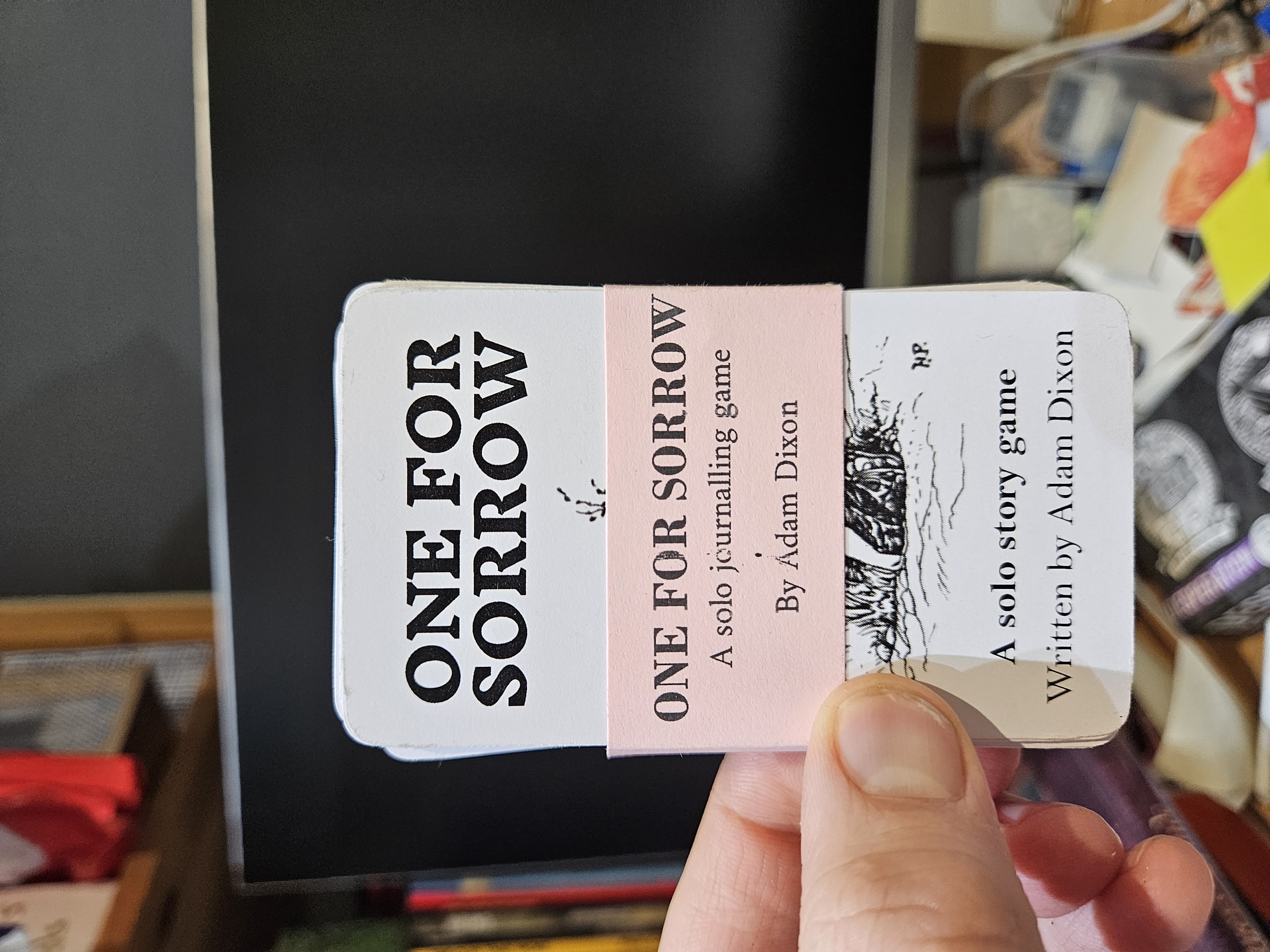
One For Sorrow is a solo journalling game by Adam Dixon1 of Furtive Shambles. It's a small deck of hand cut, hand-trimmed cards, which put together with a map you draw tell the story of a dangerous journey through a forest.
This is a small game so barring any fascinating game design insights it'll probably be a short review, too.
Why do I have this?
Marx Story Time: Back when I was a TTRPG greenhorn (such days did once exist), I was on the lookout for podcasts that featured games that weren't the dragon game. One of the first ones I found was Feelings First, a podcast that dealt with PbtA games that I liked at the time: Monsterhearts and later Under Hollow Hills. One of the players on Feelings First, Luke Wildwoods, recommended another podcast to me -- These Flimsy Rituals -- which I started listening to very close to the beginning. Amongst other things, TFR has been playtesting Furtive Shambles' big game Ryne, which is pretty close to release at time of writing after a successful Indiegogo campaign in 2022. I also interviewed Adam and Thryn for Yes Indie'd Pod, and we've been friends since -- I hang out in their Discord server, we chat about games and coops, and I tabled next to them at Leeds Zine Fair. Which, incidentally, is where I picked up One For Sorrow.
Level of review: Deep Dive
This is a short game, so I'll read the whole thing. As a lightweight solo journalling game it's also probably the most accessible to me to play, so it stands a good chance of being a playthrough candidate in the future.
Vibe Check & Flick-Through
First impressions: One For Sorrow is small! It's a deck of 57mm x 100mm cards, about 15mm thick, in black and white ink on medium-weight cardstock. Thryn told me he'd cut and trimmed all the decks by hand, which is a nice touch; given the rounded corners this must have been a pain! It also has a belly-band, which is a nice touch as it holds the cards together (note to self: buy a box for this game).
The art is all from British Library P.D. images, which I really like; the style is a combination of woodcut/lineart and zoological illustrations, and they all work really well in cahoots. I particularly like the card back art, which is a lineart drawing of a branch with fruits and leaves, with bells on strings wrapped around it.
The cards themselves are divided into four sections, à la For The Queen, with the front matter taking up three cards, the instructions taking twenty, seven cards of character art, and the remainder as prompts. This is convenient from a production point of view, but personally I find it a bit annoying to separate the decks when I'm playing. I'd prefer, at least for solo play (notwithstanding that this format works very well for For The Queen), a little booklet of instructions separate from the cards, and indeed the front matter presented on a box, but this is a DIY product and I probably should be less critical because I do in fact like the format a lot.
Very good typeface and size choices here: the layout is very readable, and works well to convey information. Overall, there's a really good attention to detail on how One For Sorrow has been made.
A special mention to the "flavour text" card, which is a version of a traditional British rhyme about counting magpies2:
One for sorrow,
Two for mirth,
Three for a funeral,
Four for a birth,
Five for heaven,
Six for hell,
Seven for the Devil,
His own self
This is very different to the one I know; for the record, I imagine there are hundreds of versions of this rhyme, but the one I know is from the Midlands: sorrow / joy / girl / boy / silver / gold / secret ne'er to be told. At any rate, it's where the name of the game comes from, and makes me very intrigued as to how it relates to the content of the game. Let's dig in.
Deep Dive
One For Sorrow, whilst being in a familiar Descended from the Queen format, offers three mechanical twists which separate it from the chaff: firstly, it's solo, so you play a fellowship of seven archetypes travelling together; second, it sees you going through the deck multiple times before you hit the ending, which greatly extends your play cycle; and third, it has map-making mechanics embedded into it to give you an artefact of play at the end.
Dixon has used these changes very effectively: characters can disappear from your game at the turn of a card, or be marked in some way which develops their story, which gives you both more depth and more control over your story (you're usually allowed to choose which of your characters go). This is in contrast to other solo games where you embody one character, so every twist and turn has to affect them and only them. Here you can develop a number of parallel stories, and make agonising decisions over which of your darlings to kill. It's a clever way to keep interest high; plus, the archetypes are vague and familiar: what does Magpie, Finch, Crow mean to you? I can imagine.
The reshuffling mechanics are great, too. The cards have three prompts, linked in a thread of change and degradation, and as you draw or redraw them you progress through the thread. Sometimes this leads to a character dying from something seeded earlier in the story, and this is a smart little tool which would be oh-so-simple to integrate into other card-based games.
Tracking these might be a bit annoying, but you're instructed to write on or otherwise mark the cards3 so I guess it's an extension of that. Yes, this mechanic is easy to bypass; yes, you don't have to mark the cards. I think you'll lose something of what Dixon wants to get across if you don't, but I want the replayability because the mechanics are delicious.
The map-making is, I think, a little undercooked. I didn't really spot enough prompts that make you draw parts of your journey. I think that's a shame; I would have had most of the first prompts on a card encourage you to draw. To me, map-making is freeing and exciting, it's so much easier in solo mode where you're not being observed (looking at you, The Quiet Year), and it gives you something to look back on when you're done.
The prompts, though, are great: evocative, interesting, challenging, fruitful. There are dark themes and lighter ones, clever ideas and funny ones. They're not specfic to the kind of journey or the kind of characters: you could tell this story in any discrete space, like a tangled underworld or the belly of a giant spaceship. Your characters could be literal birds, or woodland spirits, or humans, or, iunno, disembodied hands floating through a dark void, why not. It's well executed, in short.
Another great touch is the inclusion of one card, a random weather table. It's great, I love to see weather tables in games, and I want more of these in One For Sorrow! Give me a table for what kinds of trees are around, or the time of day, or noises, or anything.
A lot of people have asked me about the form factor of the small cards and I conclude that I'm a big fan. They're easy and satisfying to hold, they can hold a surprising amount of text, and they'd fit very neatly around your map sheet, unlike those oversized tarot cards lots of games call for. Being uncoated is an advantage here too for the legacy reasons I mentioned above; they're slightly more difficult to shuffle and deal than linen or gloss finish cards, unfortunately.
For a short game, with likely fewer than a thousand words, this one packs a punch, and it plays with some interesting outline themes whilst leaving it open enough for your own colour to be added.
Final Thoughts
I really enjoyed reading through this little deck of cards. It felt like a really fresh take on a format I've seen a few times now, and I'm thrilled to have found it. The themes of dangerous travel and hard choices really come through, and there's a subtle and scary tone that runs throughout the prompts that older kids might be really into, too.
If One For Sorrow comes unstuck anywhere, it's in not leaning enough into its cool mechanics: give me more random tables, more drawing, more hard choices. With just a little bit of a tweak, this could feel like a modern masterpiece.
Masterpiece or not, you can bet your bottom dollar that I'll be playing this. I've already got ideas on who these characters are and the world they inhabit. I know how they'll die; I just don't know when. Watch this space for an updated review when I get to it.
Addendum: Adam and Thryn have told me that this game will be coming to crowdfunding for a second edition really soon. Watch this space for that, too!