Stealing Your Heart, by Joshua Fox
What is this?
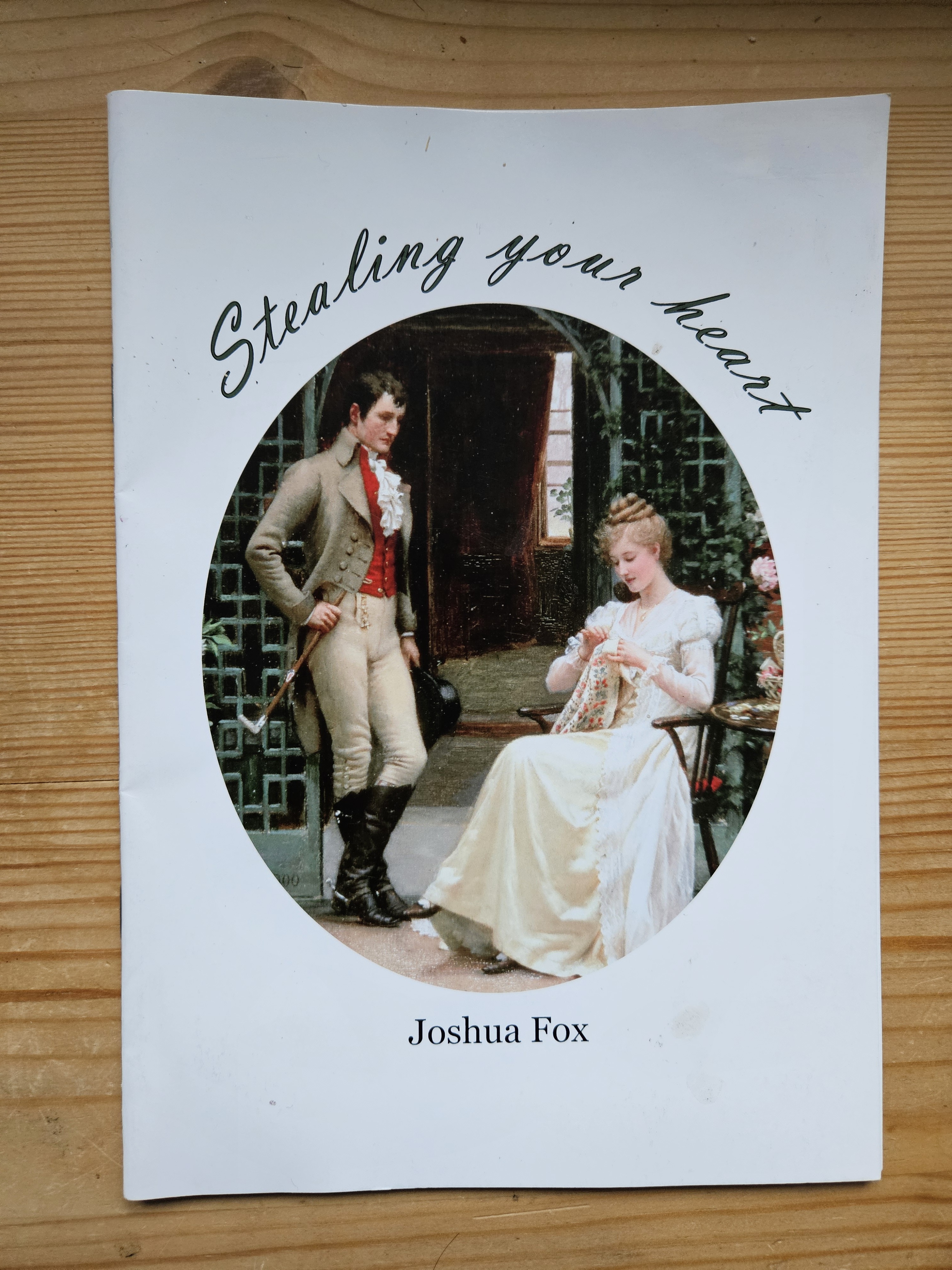
Stealing Your Heart is a short pamphlet (feels more on-point than zine here) game by Joshua Fox of Black Armada Games. It's a duet story game of Regency Era romance, and has a hidden role aspect. It was originally published to the Black Armada Games Patreon backers, and it's now being sold as a zine at various UK conventions. I have this (currently rare) print edition, which in an A5 staple-bound affair on gloss paper; twelve text pages plus covers, and a fair amount of whitespace.
Why did I get this?
Convoluted story, but basically I ran a stall at a zine fair and sold lots of games from lots of publishers. This was one of them. At the end of the event, I divvied up the cash, accepting no payment other than this zine, kindly donated by Joshua Fox.
Disclaimer, I guess: I'm on various Discord servers with Josh, and I'd say he was a friend. He's helping playtest one of my games, and is always generous and helpful with his advice.
Level of review: Deep Dive
This is short enough for me to read every word1, so I have done. I've not heard it or seen it played, and I haven't played it myself.
Vibe Check
The cover is pretty simple, with a curly display font curving over an oval-cutout view of a Regency Era oil painting, featuring a standing man and a sitting woman. Combined with the title, it definitely conveys this feeling of "this is going to be a game about Regency romance"; indeed, the twist to this story (that one of you is a thief) is not made obvious until you read the blurb on the back.
Having listened to Joshua Fox on the Black Armada Tales podcast, I can hear the blurb in his voice, which is a nice touch. It definitely reads as the descriptor for a (perhaps particularly trashy) Regency romance spoof.
One thing I always like on the back cover of game books is telling you how many players you need, how long to plan for (and this has two recommendations!), and what you need to play. Greatly appreciated.
Flick-through
The pamphlet is pretty sparse -- a lot of whitespace, a few public domain images, and quite a lot of relatively small text. For me, this gives a kind of "novel" impression, which is quite nice given the source material. The P.D. images are well chosen and don't dominate the pages.
The headings font is a lovely calligraphic display font, but for me it's too small and I can't process it at speed, which is useful for a game book that you refer to in play (as here). I also don't like the way the tables are laid out, but I'm aware this is quite fussy and they're actually very functional. I guess the clincher is that it's a Patreon game and we shouldn't expect all-singing, all-dancing layout design here.
Credits for images and playtesting (by Becky Annison) are on the back page, and a timely shout-out to Patreon backers who made this possible (and presumably got it for free).
Deep Dive
The zine is broken down into introductory material (character creation and a note on how to play romance), a little bit of general Regency tropes, which is quite a succinct description of the genre, the structure of the game and its mechanics, and then how to play out the three Acts in detail.
The Set up is fairly straightforward, being: choose or roll a name, choose who is the scoundrel, and finally picking a couple of other traits each for flavour. This being a story game, not very much of this has an impact on the mechanics of play. I think there's a table (of loot!) missing, which is a shame. This kind of leads into a wider point, which is that the whole thing could have done with a decent editorial pass; again, it's a Patreon game for backers, so we shouldn't expect perfection.
The section on how to do full-blooded romance in games is next: Commit to the courtship. This is a nice bit on making sure that you vamp this up a bit and lean into the ridiculous tropes of Regency novels. Having said that, there's no discussion of how to have a conversation about romance in games, which I'm in two minds about: on the one hand, particularly with the big chunky whitespace below it, it feels like an omission in games which deal explicitly with love and romance; but on the other hand, this is a short game, and it's once that's about romance from the off, so presumably you've agreed to play like this.
As I said before, the Regency tropes section is really good, giving a little historical context which is useful for the casual reader (me), and a decent two-page list of "handy trappings of the genre" which would be very useful in this game (or indeed in any Regency Era game). It's also really interesting to have such a common genre deconstructed in front of you.
The mechanics of Scenes comes next. It's clear how this game is intended to work: it's a trick-taking mechanic, with who wins and how hands are built changing throughout the three acts (courtship, betrothal, and marriage).
The choice of playing with cards is great for this game, because a) Regency; b) suits giving a quick narrative link to scenes; and c) the "memory" aspect of cards, which plays into the second and third acts. I really like the idea that you have a lot more agency in Act One, that cards won in Act One become your hand in Act Two, and that at least one player has no agency in Act Three. That's a really strong link between the mechanics of play and the setting itself, which is one of Fox's best design choices.
To me, it seems like the idea of one of the characters being a thief gets a little lost in the body of the game. There's a lot of the Set Up text dedicated to it, but it doesn't really make an appearance again until Act Three, at which time it's still optional. On just reading the game, maybe the power of the hidden role aspect of this game isn't as obvious, and that it would feel better in play.
There's a little epilogue to play after Act Three. A hint to story game designers: always do this. Epilogues are a fantastic way to get full closure on open story threads. When you fail to include a structured plenary to a game, then you leave your players feeling a bit hollow.
Final Thoughts
I think what Fox has done here is pretty smart: in twelve pages, with a lot of whitespace and quite a lot of images, he's managed to deconstruct our modern understanding of the genre and distill it into a nicely designed narrative game with a really interesting card mechanic behind it.
If the game misses the mark anywhere, it's leaning into the "heist" aspect; in some respects, it feels like an afterthought, although quite a well-developed one in the set-up. Actually, to me, this game would work at least as well without the theft aspect hanging over it, and there's a hint in the Set Up that you could easily randomise whether both players are scoundrels or not and play it straight. But it's a neat twist on what would otherwise.
There's also a couple of places where layout felt a bit rushed, and where it would have really benefited from the love of a good editor. But, given the context of its release to Patreon backers, I'm definitely willing to overlook these things, especially given its other charms.
Despite my lack of interest in period drama, I'm interested to play this game and find out how it works at the table, because as a duet game it's incredibly approachable, and as a romance game it's one of the easier ones to pick up and play (compare to, for example, Emily Care Boss's The Romance Trilogy or Fog of Love). There's an obvious comparison with Good Society too, and whilst I haven't read that one, it's significantly heavier in weight and longer in pages, and I'm not sure that all of that extra cellulose is going to add anything that Fox's page on Regency Tropes doesn't cover.
Overall, if you're a Regency fan, a romance fan, or a story game fan, you're likely to be interested in playing this. If you're looking for an easy pick-up game for your next duet session, it's probably worth a look, too. It certainly stole my heart.
Well, more or less.↩